
Last updated October 30, 2026
 Wrought iron
 Wood & steel frame
 Farm & ranch
 Sliding driveway gates
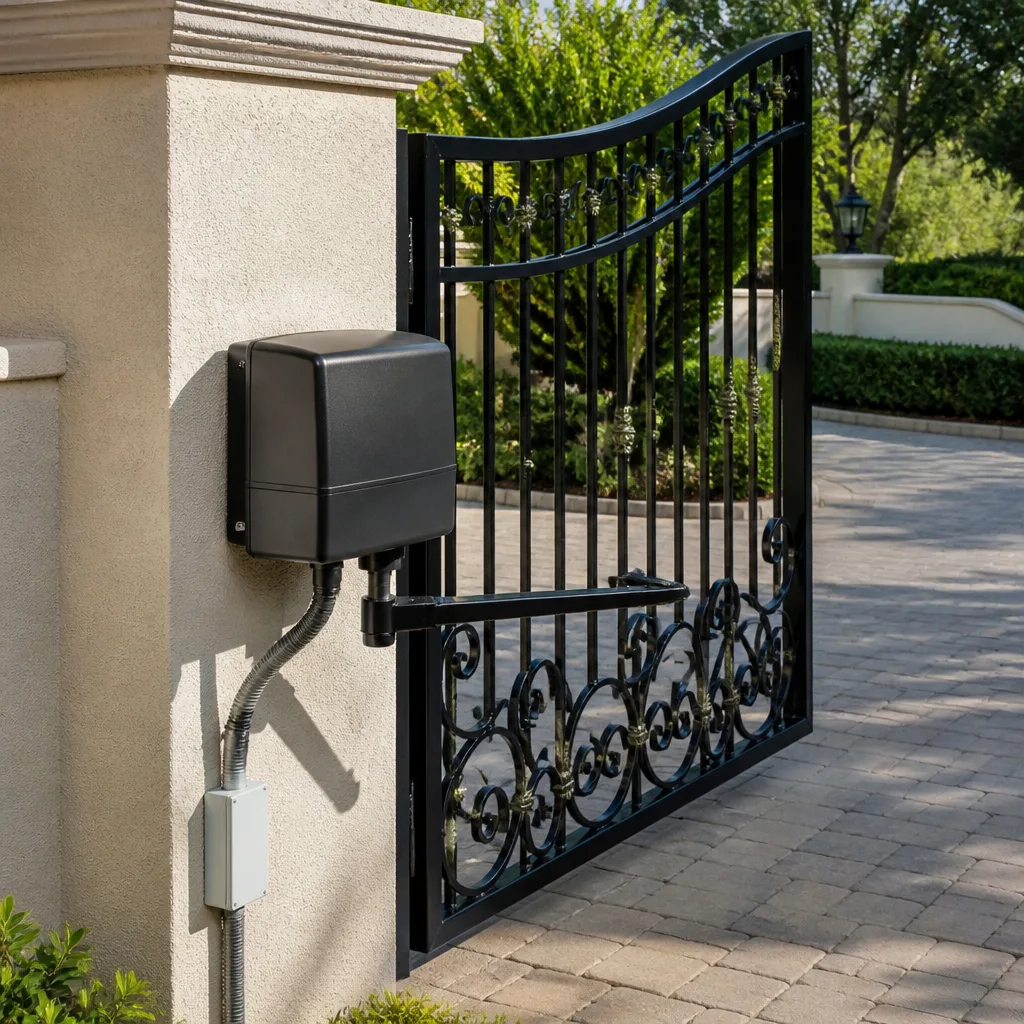 LiftMaster operators
Free on-site gate assessment - hinges, posts, and your LiftMaster or Nice gate operator checked before anything is quoted
The assessment is free and the quote is the invoice.
Get your free estimateGate Repair Cost Breakdown: The Chino Homeowner’s Reference for 2026
The cheapest gate repair quote in Chino frequently costs more than the most expensive one once you account for a return visit, parts that were substituted because the contractor didn’t stock the OEM component, and a diagnostic fee charged twice. Gate repair pricing in Chino varies by a factor of four for the same job depending on whether the contractor is a true gate specialist with parts on hand or a generalist sourcing components retail. This Gate Repair guide gives you a line-item framework to evaluate quotes, not just compare bottom-line numbers, so you know exactly what you’re paying for and where contractors pad invoices without delivering more. By the end, you’ll be able to spot the difference between a fair 2026 gate repair quote in Chino and one built to get a second visit.
Styles & brands we work with
Quick Answer
Gate repair costs in Chino in 2026 typically range from $160 to $2,800 depending on the repair category. Basic hinge replacement runs $160 to $420, control board replacement runs $450 to $1,000, and a full operator replacement (motor and control unit) ranges from $1,100 to $2,800 depending on whether you have an entry-level LiftMaster or a commercial Viking hydraulic unit. Labor dominates most small repairs, while parts dominate control board and operator work, and a legitimate diagnostic fee in Chino is $65 to $125, credited toward your repair if you proceed.
Table of Contents
- What Actually Drives Gate Repair Pricing in Chino
- 2026 Repair Cost Breakdown by Category
- Understanding Diagnostic Fees: What’s Legitimate, What’s a Red Flag
- OEM vs. Aftermarket Parts: What You Give Up for Savings
- Labor Variables: Why Some Operators Take Twice as Long to Replace
- How to Read a Gate Repair Quote for Padding
- Chino-Specific Considerations: Climate, Code, and Market Reality
- Common Mistakes to Avoid
- When to Call a Professional
- Frequently Asked Questions
- The Bottom Line
What Actually Drives Gate Repair Pricing in Chino
Before we get into specific dollar figures, it’s worth understanding why two quotes for the same hinge replacement in Chino can land $300 apart. Because the spread is not random. It’s predictable once you understand the three variables that dominate every gate repair invoice: parts cost and source, labor time and expertise, and the contractor’s business model. A gate specialist who works exclusively on gates stocks common parts, knows brand-specific failure patterns, and prices jobs to be done in one visit. A generalist who fences on Monday, hangs a garage door on Tuesday, and looks at a gate on Wednesday sources parts after the diagnostic visit, often pays retail, and sometimes improvises with a substitute that causes a callback.
In Chino specifically, the market adds another variable. Much of the housing stock built in the 1990s and early 2000s came with developer-installed tubular steel pedestrian gates and basic slide-gate motors from the era. Those gates are now 20 to 30 years old. The original operator brands are often discontinued or revised. That means a hinge repair on an older Chino gate frequently requires a retrofit bracket or a custom pin, not just a straight swap. Our Gate Repair in Chino service exists precisely because this kind of aging-inventory work is different from fixing a gate installed three years ago. A generalist quoted against a specialist will low-ball the straightforward version of the job, then ‘discover’ the retrofit complication after they’ve started.
2026 Repair Cost Breakdown by Category
Here are the real cost ranges we see across Chino in 2026, broken out by repair category. These are total job prices including parts and labor, not just the part cost. If a quote falls below the low end of these ranges, ask what’s being left out. If it’s above the high end, ask for a line-item breakdown.
Hinge and Pintle Replacement
Hinges fail gradually. A gate starts sagging, the latch no longer lines up, and one day the gate drags on the concrete. In Chino’s dry climate, the failure mode is usually bearing wear in the hinge barrel, not rust-through like you’d see in coastal cities. The fix is replacing the hinge set, which typically requires lifting the gate off its pintles, cutting or unbolting the old hinges, welding or bolting new ones, and re-hanging. Depending on gate weight (a wrought iron driveway gate can weigh 400 to 900 pounds), the total job lands between $160 and $420 for a pedestrian gate and $350 to $900 for a double driveway gate with four hinges and alignment work. Expect the quote to specify whether hinge replacement includes re-welding support gussets or just a bolt-on swap. The difference matters for how long the fix lasts.
Gate Operator Replacement by Tier
Operator replacement prices split cleanly into two tiers: entry-level electromechanical operators and commercial or high-cycle hydraulic units. Here’s what we see in Chino in 2026:
- Entry-level electromechanical (Mighty Mule, Ghost Controls, basic Linear): $1,100 to $1,600 installed, including the operator, new brackets, limit setup, and force adjustment.
- Mid-range electromechanical (LiftMaster LA400/LA412, BFT Deimos): $1,500 to $2,200 installed, with OEM control board, radio receiver, and safety photo eye included.
- Commercial hydraulic (Viking, higher-end FAAC): $2,300 to $2,800 for the operator itself, plus additional labor if the hydraulic pump, reservoir, or hoses need replacement beyond the motor unit.
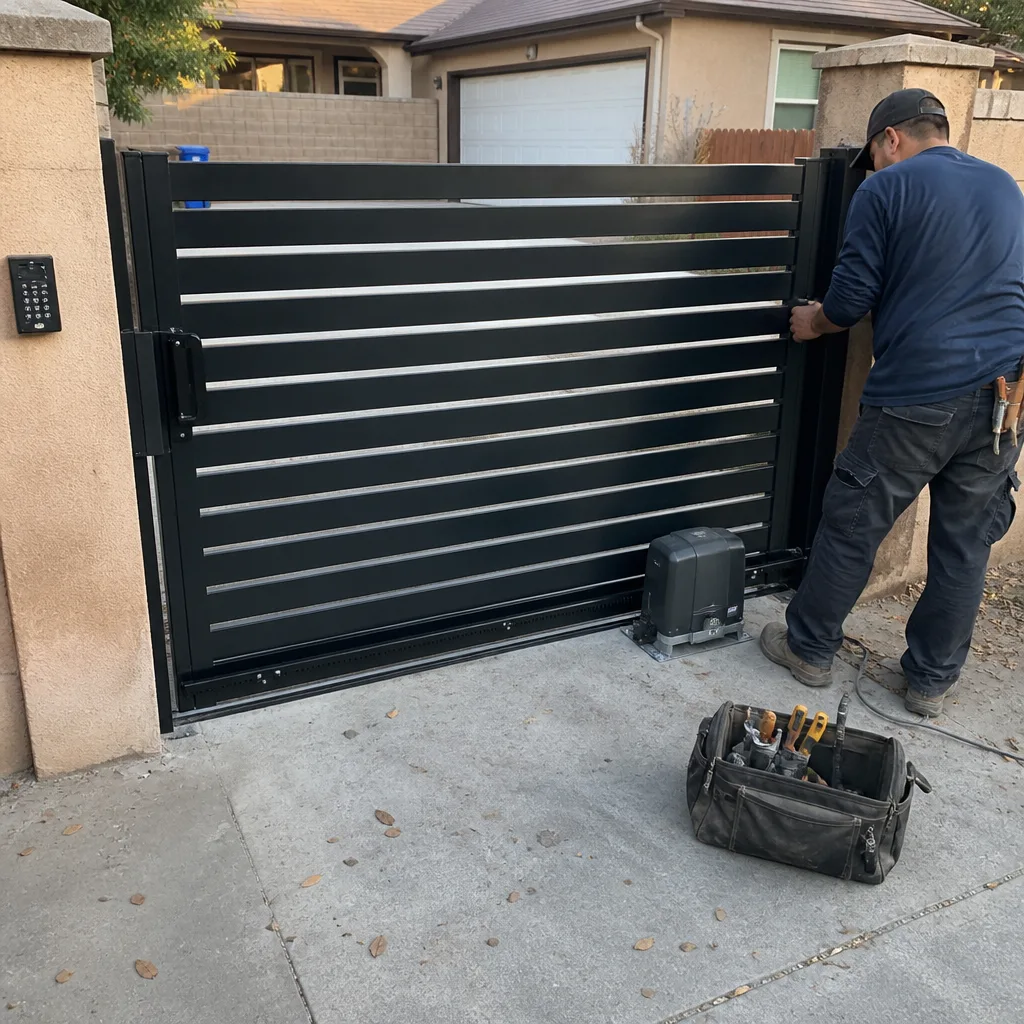
The tier difference is not just the part cost. A Viking hydraulic operator requires checking hydraulic fluid condition, bleeding the system if lines were opened, and often fabricating a new mounting plate because the old unit’s footprint doesn’t match. An entry-level Mighty Mule swing arm is a two-to-three hour job. A commercial Viking hydraulic swap can be a full day. When you’re comparing quotes, the bottom line isn’t enough; you need to see whether the contractor understands the difference. That’s why a gate-only company with brand-specific experience across the major label range matters on replacement work. If you’re replacing a failed motor, our Electric Gate Repair in Chino page explains what’s involved in diagnosing whether the operator itself or the control board is the actual failure point.
Control Board Replacement
Control boards fail from power surges, heat exposure, and plain age. The repair itself is usually quick: unbox the board, transfer the wiring harness, set the DIP switches or program the new board, test the cycle. The cost is dominated by the part. In Chino in 2026, OEM control boards run:
- LiftMaster LA400 main control board: $280 to $430 parts; $450 to $650 installed.
- Viking F-1 or L-3 control board: $350 to $520 parts; $520 to $780 installed depending on enclosure condition.
- FAAC 455D control board: $300 to $450 parts; $480 to $700 installed.
- Linear APeX or Elite residential board: $220 to $380 parts; $400 to $600 installed.
If a quote comes in at $180 for a ‘control board replacement,’ the contractor is either installing an aftermarket generic board (see the next section) or replacing a smaller accessory like a receiver card, not the main controller. Ask exactly which board and which brand.
Safety Sensor Realignment and Replacement
Photo eyes get knocked out of alignment, especially on gates that see daily vehicle traffic. A chip in pavement, a bump from a delivery truck, a shift in soil from Chino’s summer heat-dry cycle, and the beam no longer lines up. Realignment is the least expensive fix in gate repair: typically $95 to $160 including trip. But if the sensor itself has failed, replacement runs $180 to $320 for a generic photo eye and $250 to $420 for an OEM pair that matches your operator. The most common mistake is paying for a new sensor when the old one only needed cleaning and alignment, so ask for a clear diagnostic on whether the sensor is transmitting before approving the replacement. This is the kind of small-job credibility check that separates careful money from wasted money.
Track and Roller Service for Slide Gates
Slide gates move on rollers that bear the full gate weight, and those rollers wear out by design. Rollers should be greased and adjusted annually. When they’re neglected, the gate starts grinding, the motor works harder, and eventually the roller axle or the track itself deforms. In Chino, where the soil contracts and expands with irrigation and dry seasons, the concrete pad under a slide gate shifts slightly over time, which changes track alignment and accelerates roller wear. Roller replacement is $180 to $400 per gate, depending on how many rollers and whether the track needs grinding or shimming to restore a level surface. Full track replacement on a corroded or deformed track runs $600 to $1,200 because it’s not just the track; it’s cutting out the old rail, setting a new one in epoxy-anchored bolts, and re-leveling the gate. If a contractor quotes track replacement without mentioning re-leveling the gate after, they’ve quoted half the job.
One note on this category: if your gate is beyond repair, our Gate Installation in Chino page covers what goes into full replacement and how to decide whether repair still makes sense.
Understanding Diagnostic Fees: What’s Legitimate, What’s a Red Flag
A legitimate diagnostic fee in Chino in 2026 is $65 to $125 for a gate that won’t open. That fee covers the trip, the time on site, and the expertise needed to isolate the failure from a dozen possible causes. Most reputable contractors waive the diagnostic fee against the repair cost if you approve the work on the same visit. That’s the standard. When you call a gate specialist, the diagnostic time is a real cost to the business, and a company that doesn’t charge for it has to recover that time somewhere else, usually in padded parts pricing or labor rates.
A $0 diagnostic offer is a pricing red flag, not a bargain. Here’s how the economics work: a contractor who doesn’t charge for diagnosis has an incentive to find a problem, any problem, that justifies a repair and a parts markup. If the actual issue is a loose wiring nut that takes ten minutes to fix, and the contractor doesn’t get paid for the hour of driving and diagnosing, the natural financial move is to sell a $400 ‘preventive’ part replacement you don’t need. A paid diagnostic with a credit against repair removes that incentive. The contractor gets paid for expertise whether you proceed or not, and you get a truthful assessment. That’s the relationship you want.
There’s one exception worth knowing: when the diagnostic fee is charged twice. That happens when a contractor quotes a repair, orders a part, returns, and bills you a second trip fee on top of the repair. In Chino, the legitimate pattern is one diagnostic fee, credited once, with no second trip fee for a repair the contractor quoted. If the second visit has its own line item for ‘trip charge’ or ‘return visit,’ that’s a fee structure designed to extract extra money from a captured customer. Ask before you approve: ‘Is the diagnostic credited against this total, and is there any additional trip fee when you come back with the part?’ The answer tells you more about the contractor than the quote total does.
OEM vs. Aftermarket Parts: What You Give Up for Savings
The largest savings opportunity in gate repair is also the largest long-term risk: aftermarket control boards and operator components. OEM parts are the manufacturer’s own parts, made to the original spec, warrantied by the brand, and programmed with the same compatibility guarantees the operator was designed for. Aftermarket parts are produced by third parties, often reverse-engineered from the original, sometimes with components that approximate but don’t match the OEM spec. The price difference is real. An aftermarket LiftMaster control board might run $110 versus $340 for the OEM. On a Viking operator, the gap can be $180 versus $480.
What you give up with aftermarket, beyond the obvious warranty differences, breaks into three practical costs:
- Programming and compatibility risk: Aftermarket boards don’t always talk correctly to the original receiver, limit switches, or remote controls. The board works on the bench and causes intermittent faults in the field. Those faults cost diagnostic visits.
- Longevity mismatch: An aftermarket board rated for fewer cycles than the operator’s original spec is a time bomb. In a Chino HOA or commercial setting where the gate cycles hundreds of times a day, that’s the difference between seven years and eighteen months.
- Warranty accountability: If an OEM board fails in the first year, the manufacturer’s warranty replaces it. If an aftermarket board fails, the contractor who chose to install it may or may not stand behind it, and the manufacturer certainly won’t.
Our position is straightforward: we quote OEM parts by default because chasing a phantom fault for six months costs more than the board savings ever delivered. If a customer specifically wants aftermarket to hit a budget number, we’ll tell them what they’re trading away and let them make the call. That’s the kind of clarity you should expect from any gate contractor in Chino, and if a quote lists a brand name on the part, ask whether that part is OEM or ‘equivalent.’ The word ‘equivalent’ is doing heavy lifting and you should know exactly what it’s lifting.
Labor Variables: Why Some Operators Take Twice as Long to Replace
Two gate operators that look identical on a shelf can have very different labor requirements, and the difference should show up in your quote. The vehicle for understanding this is the distinction between electromechanical and hydraulic operators. An electromechanical unit uses an electric motor, a gear reduction, and a drive arm or chain. The replacement is largely mechanical: unbolt the old unit, mount the new one, connect power and limit switches, program the travel, test. A BFT or Linear electromechanical swing operator is typically a two-to-four hour job.
A hydraulic operator like a Viking or a heavier FAAC unit uses an electric motor driving a hydraulic pump that moves the gate through hydraulic pressure. These systems have additional components: a reservoir, hydraulic fluid, hoses or internal channels, valves, and sometimes a separate control enclosure. Replacing the operator means checking the condition of every one of those dependent components. If the old unit leaked fluid into the enclosure, the new motor mounts into a contaminated space that needs cleaning before anything gets reinstalled. If the hoses are cracked from Chino’s summer heat cycling, replacing the operator without replacing the hoses guarantees a leak within months. The labor difference is real: expect a hydraulic operator replacement to run one and a half to two times the labor hours of an equivalent electromechanical swap, even if the part price is similar.
What this means on a quote: if you’re comparing two contractors and one lists a flat ‘$X for operator replacement’ with no reference to whether the system is hydraulic or electromechanical, that contractor hasn’t asked enough questions to give you a real price. The quote is either a lowball that will be corrected after disassembly, or a padded number that overcharges for a simple swap. A competent gate specialist in Chino will ask what brand and model you have, whether it’s hydraulic or electromechanical, and quote accordingly. If you don’t know, they should factor a brief diagnostic into the first visit before committing to a price. That’s not dodging; that’s honesty.
How to Read a Gate Repair Quote for Padding
Most homeowners reading a gate repair quote focus on one number at the bottom, which is exactly what a padded quote counts on. The line items tell the real story. Here’s a step-by-step method for reading any gate repair quote in Chino and spotting the three most common padding techniques.
- Look for line items versus a lump sum. A legitimate quote breaks out parts, labor, and any trip or diagnostic fees as separate lines. A quote that says ‘labor and materials: $1,450’ with no breakdown is asking you to trust a number you can’t audit. Ask for the breakdown. If the contractor can’t or won’t provide it, that’s an answer in itself.
- Check the parts line against known OEM pricing. You don’t need to be a gate expert to sanity-check parts. Buyers can look up a LiftMaster or Viking control board price online in minutes. If a quote lists a part at 50% above the readily available retail price, that’s a markup on top of labor, and you should ask why. Some markup is legitimate; a contractor is not a parts warehouse, and carrying inventory costs money. But undisclosed 100% markup on a part the contractor was going to buy retail anyway is padding.
- Look for trip fees that appear after the estimate. A trip fee that’s disclosed upfront and credited against the repair is standard. A trip fee that shows up for the first time on the final invoice or as a separate line on the return visit is the kind of fee structure that adds $90 to $150 to the job without changing the work. Ask, before approving anything: ‘Are there any other fees beyond what’s on this quote?’ If the answer is yes, get them in writing on the quote. If the answer changes later, you have the original written confirmation.
One more pattern worth flagging because it’s becoming more common in Chino: the quote that’s actually two quotes stacked. You approve a hinge replacement for $350, and the technician ‘discovers’ a ‘safety issue’ with the operator that’ll be another $600 to address. Sometimes that discovery is legitimate. Older gates often have multiple worn components. But when the second quote arrives after the first job is started, you’ve lost the ability to compare. Protect yourself by asking at the diagnostic stage: ‘Is there anything else on this gate that’s nearing failure or that you expect to need work in the next year?’ A gate specialist who works on these systems daily can usually tell you on the spot what’s marginal. If a follow-on repair was foreseeable and the contractor didn’t mention it until the first check was cut, that’s not discovery. That’s sequencing.
Chino-Specific Considerations: Climate, Code, and Market Reality
Chino’s specific geography shapes gate repair in ways that don’t show up in generic cost guides. The inland Southern California climate, with its hot dry summers, cool mornings, and occasional Santa Ana winds, affects gate components and the repairs they need, as detailed in our Gate Repair Emergency Preparedness Guide for Chino Homes. The regulatory and market environment does the rest. If you live in Chino or manage property here, these factors explain why some repairs are predictable and why some are necessary regardless of how well the gate was maintained.
The first climate factor is thermal expansion. In Chino’s summer, daytime temperatures regularly cross 100 degrees, and gate materials, particularly steel and aluminum, expand measurably. A gate that clears its latch in January may stick in July. A chain that runs tight in the morning may slacken by afternoon. Contractors who don’t account for seasonal expansion in their adjustments set a gate to work in March that binds in August. This is why proper tensioning and clearance setup matters more than the labor rate, and why a gate that was ‘perfectly adjusted’ after a winter repair can need a follow-up tweak during peak heat. It’s not a defect; it’s physics.
The second factor is Chino’s municipal permitting and code environment. Chino requires permits for new gate installations and for some significant modifications, particularly anything that changes the footprint or the power connection. Repair-only work, like replacing a hinge, a control board, or an operator on an existing compliant installation, typically doesn’t trigger a permit. But if you’re upgrading from a manual gate to an electric operator, or adding automation to a gate that was manual, that’s an installation, not a repair, and the city treats it differently. We handle this distinction as part of our Gate Installation in Chino service, and the permitting question is why ‘just add a motor to the existing gate’ is sometimes a bigger job than homeowners expect.
The third factor is market density. Chino’s housing stock includes a higher-than-average concentration of gated communities, Equestrian-zoned properties, and commercial/industrial lots along the Chino Valley corridor, all of which rely on gate systems for security and access. The result is a contractor market with more gate work available than generalist time to do it, which is why gate specialization matters. A generalist can quote a lower price because they haven’t learned, through repeated exposure, which failures are common on 20-year-old Chino gates and which fixes will hold. The cheapest quote often comes from the least specific knowledge, and as we’ve said, it often costs more by the end.
Common Mistakes to Avoid
- Comparing quotes by bottom line only. Two quotes $500 apart often hide a $900 difference in what’s actually included. Read the line items, not just the total.
- Accepting a $0 diagnostic without asking how the contractor gets paid. A free diagnostic fee is a pricing strategy, not a kindness. It creates an incentive to sell repairs you may not need.
- Choosing aftermarket parts to save money without knowing the trade. Saving $200 on a control board that fails in eighteen months and requires another $125 diagnostic visit costs more than the OEM part would have.
- Telling a contractor ‘just make it work’ without asking what’s actually wrong. That instruction invites a temporary patch instead of a real repair, and the gate fails again on the hottest day of summer.
- Neglecting the gate’s moving parts between repairs. A $95 sensor realignment is preventable with annual roller greasing and track cleaning, and a $350 hinge replacement is preventable with earlier attention to a sagging gate.
- Not asking whether the quote includes permits. If the job is technically an installation rather than a repair, a permit is required in Chino, and a quote that omits it hides a cost and a compliance problem.
- Assuming the first contractor who answers is the only option. Gate repair is specific enough that two or three quotes are worth the time, but only if you’re comparing like-for-like work, not just numbers.
When to Call a Professional
Some gate problems are worth attempting yourself: cleaning photo eye lenses, tightening visible bolts, lubricating hinges. Others are not. If your gate is sagging to the point where it drags, the hinges have worn beyond adjustment and replacement requires lifting a heavy, possibly loaded metal gate, a job with serious pinch and crush risk. If your operator makes a grinding noise or trips a breaker, the failure is electrical or mechanical inside a powered system and opening the enclosure without understanding the wiring is dangerous. If the gate stopped working after a wind event or vehicle impact, the frame may be bent, and continuing to operate it can tear out the operator mount or drop the gate off its track. High-tension springs on some older gate mechanisms carry stored energy that releases unpredictably; a trained professional knows how to manage that release safely. For any of these scenarios, schedule an assessment. Wrought Gate Repair offers free estimates in Chino, call (833) 545-6817 and we’ll give you a straight assessment of what’s actually wrong before any repair is quoted.
Frequently Asked Questions
Gate repair in Chino in 2026 typically costs between $160 and $2,800, with most repairs landing between $250 and $650. The spread is driven by the repair category: hinge replacement is the least expensive, control board replacement sits in the middle, and full operator replacement is the most expensive. The single largest variable is whether your gate uses an entry-level electromechanical operator or a commercial hydraulic unit, which changes both parts cost and labor hours. Call (833) 545-6817 for an exact quote on your specific gate, estimates are free.
A legitimate gate diagnostic fee in Chino in 2026 is $65 to $125, and it should be credited against your repair cost if you approve the work on the same visit. This fee covers the trip, on-site diagnosis time, and the expertise to isolate the failure from multiple possible causes. A $0 diagnostic fee is a red flag because it creates a financial incentive to recommend repairs you may not actually need.
OEM parts are the safer choice for gate repair in Chino because they carry the manufacturer’s warranty, guarantee compatibility with your operator, and are built to the original cycle rating. Aftermarket parts are cheaper, often by $100 to $300 on control boards, but they carry higher risk of compatibility issues, shorter lifespan, and warranty gaps. In high-cycle settings like HOA gates and commercial entrances, the long-term cost of aftermarket parts typically exceeds the upfront savings.
A hydraulic gate operator costs more to replace because the job involves more than swapping a motor unit. Hydraulic operators have a pump, reservoir, fluid, valve, and often a separate control enclosure, each of which must be checked and often serviced as part of the replacement. The labor is typically one and a half to two times that of an electromechanical swap, which drives the total price up even when the operator part cost is similar.
Simple repairs like sensor realignment, hinge adjustments, and some control board replacements can often be handled same-day by a well-stocked gate specialist in Chino. More complex work, especially operator replacement requiring a specific brand part, may require ordering and a scheduled return visit. A contractor who stocks common OEM parts across major brands like LiftMaster, Viking, FAAC, and BFT is much more likely to complete the repair on the first visit, as covered in our Gate Repair Maintenance Checklist for Chino Homeowners.
Repair work on an existing gate, like replacing hinges, control boards, sensors, or an operator on an already-automated gate, typically does not require a permit in Chino. If the work changes the gate’s footprint, adds automation to a manual gate, or involves new electrical runs, the city may require a permit. A reputable contractor will tell you upfront whether your project falls into repair or installation territory. Call (833) 545-6817 with your gate’s details and we’ll help you sort out which category applies.
The Bottom Line
Gate repair pricing in Chino rewards homeowners who read quotes as line items rather than bottom-line numbers. The fourfold price spread for the same job comes down to whether the contractor is a specialist with inventory and brand knowledge or a generalist pricing a guess. Diagnostic fees, when legitimate, protect you from inflated repair recommendations. OEM parts cost more upfront and less in the long run. And labor differences between hydraulic and electromechanical systems are real, not padding. Apply this framework to any quote you receive and the cheapest bid will stop looking cheap, the most expensive will stop looking expensive, and you’ll be able to choose based on what’s actually being done to your gate. For a specific quote on your Chino gate, call (833) 545-6817 and we’ll walk you through the line items ourselves.
Written by the team at Wrought Gate Repair, serving Chino since 2012. For more guides & resources, visit our blog.
See the difference
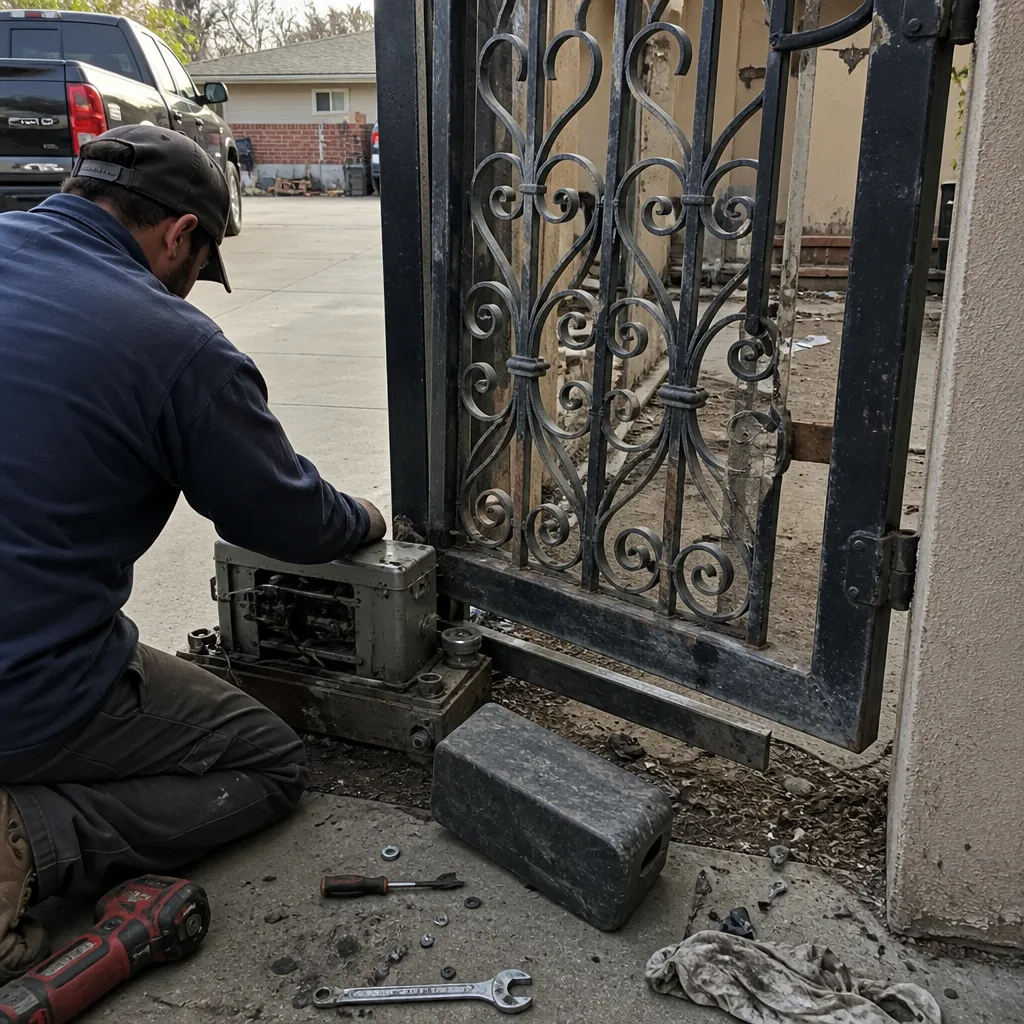 Before
 After
 Before
 After
 Before
 After