
Last updated October 30, 2026
 Wrought iron
 Wood & steel frame
 Farm & ranch
 Sliding driveway gates
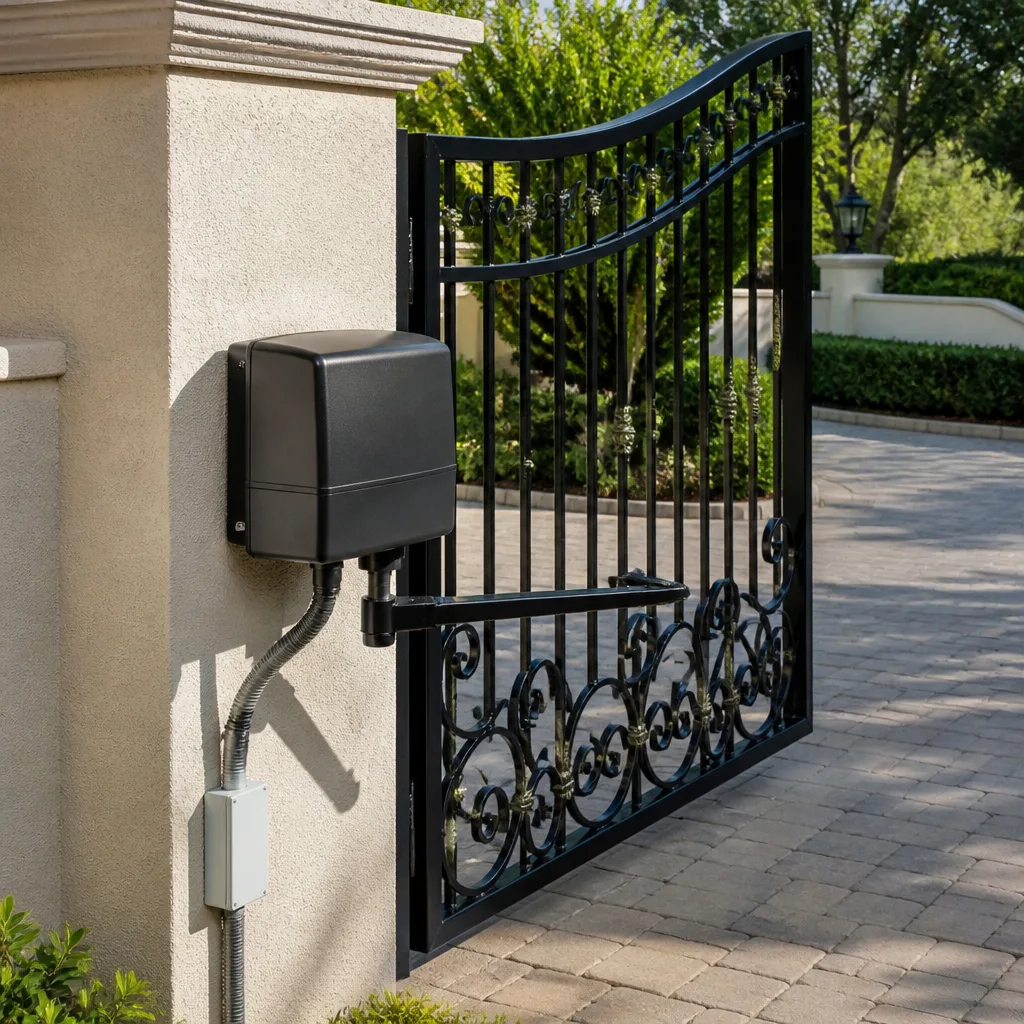 LiftMaster operators
Free on-site gate assessment - hinges, posts, and your LiftMaster or Nice gate operator checked before anything is quoted
The assessment is free and the quote is the invoice.
Get your free estimateGate Repair Troubleshooting: Common Problems and How to Fix Them
Most gate troubleshooting guides start from the assumption that if your gate misbehaves, the motor or the control board is probably failing. That assumption sells a lot of expensive operator replacements. But in our experience working on gates across Chino and the surrounding Inland Empire, roughly four out of five gate failures involve something far simpler: a misaligned photo eye, a dead battery in a remote, a limit switch that drifted out of position, or a hinge that has slowly sagged over years of thermal cycling. This guide walks you through a symptom-first diagnostic approach – because replacing a $900 operator over a $12 switch is the most common and most costly mistake homeowners make. We’ll cover the seven most frequent gate behaviors, how to tell a control board issue from a mechanical obstruction, what those blinking indicator lights on your LiftMaster, FAAC, or BFT board actually mean, and which checks are safe to do yourself versus which ones belong in the hands of a gate specialist.
Styles & brands we work with
Quick Answer
Gate repair troubleshooting should always begin with the symptom, not the suspected part. A gate that won’t open, reverses mid-travel, or runs slowly is usually suffering from a sensor misalignment, a mechanical bind, or a limit switch fault – not a dead motor. Check the simplest explanations first (power, remote batteries, photo eye alignment, visible obstruction) before assuming the operator or control board has failed.
Table of Contents
- The Seven-Minute Symptom Tree: What Your Gate Is Telling You
- Control Board Failure vs. Operator Failure vs. Mechanical Obstruction
- Brand Diagnostic Quirks: What LiftMaster, FAAC, and BFT Lights Actually Mean
- What You Can Safely Inspect Yourself (and What You Shouldn’t)
- How to Document the Malfunction So a Technician Fixes It on the First Visit
- What Chino’s Climate and Soil Do to Gates
- Preventive Maintenance That Extends Gate Life by Years
- Common Mistakes to Avoid
- When to Call a Professional
- Frequently Asked Questions
- The Bottom Line
The Seven-Minute Symptom Tree: What Your Gate Is Telling You
Before touching anything, stand at the gate and observe it through one full cycle. How far does it travel? When does it stop? Does it slow down before stopping, or stop abruptly? Does it make a sound at all? These observations narrow the problem down faster than any tool. Here are the seven most common gate behaviors and what each one points to.
1. Gate won’t open at all
No response from the remote, keypad, or any input usually means a power interruption first. Check whether the operator has power (look for a lit status LED or a hum). If the gate makes a clicking sound but doesn’t move, the capacitor or the starter may be the issue. If it does nothing – no click, no hum, no light – check the outlet or circuit breaker before assuming anything about the operator itself. A tripped GFCI outlet is one of the most common silent killers of gate openers in Chino, especially after the kind of heavy rain we saw during the 2023 winter storms.
2. Gate won’t close
A gate that opens fine but refuses to close is nearly always a safety sensor issue. The photo eye (or “safety edge”) is telling the control board that something is in the gate’s path, even if the path looks clear. Misaligned photo eyes, a leaf stuck in front of the sensor lens, or direct sunlight hitting the receiver at a low angle can all trigger this. In Chino, where late-afternoon sun sits low against the San Gabriel Mountains from October through February, we see a surge of “won’t close” calls every fall as the sun hits photo eye receivers at exactly the wrong angle. Shading the sensor or realigning it often resolves the issue.
3. Gate reverses immediately after closing (or mid-travel)
This is the safety entrapment system doing its job – but a little too eagerly. A gate that reverses right after hitting the closed position usually has a limit switch set too tightly, or a safety edge that is reacting to the pressure of the closed position. A gate that reverses mid-travel, especially at the same spot every time, usually points to a physical obstruction (a rock, a root, a sagging gate section dragging on the track or the ground). The same symptom can also be caused by a “shadow reading” on the photo eye, where the sensor interprets a tree shadow as an object. Before calling anyone, check the track and the ground contact points.
4. Gate opens partially and stops
Partial travel almost always means a limit switch problem or a mechanical bind. The operator is being told – or deciding on its own – that the gate has reached its open limit before it actually has. A worn or corroded limit switch, or a gate that is binding partway through its travel (forcing the motor to work harder and triggering an overload safety stop), are the two main culprits. On vinyl and steel sliding gates, partial travel often follows a rain event in Chino, when the track shifts slightly and the gate wheel catches on a pebble or edging.
5. Gate runs slowly
Slow operation can mean a failing capacitor, a motor that is losing torque, or – most commonly – a gate that is dragging or binding and making the motor work harder. A motor that is working against increased resistance will draw more current, heat up faster, and eventually trip its thermal overload. If your gate has gotten noticeably slower over time, do not ignore it. The resistance is almost always mechanical, and the motor is the last part to fail.
6. Gate makes grinding, squealing, or rattling noise
Grinding sounds from the operator unit usually indicate a failing gearbox or drive gear. Squealing from the gate hinges or track means dry metal-on-metal contact. Rattling can mean loose mounting bolts, worn rollers, or a chain that has lost tension. In our experience, a squeal is almost always cosmetic and easily fixed with lubrication, while a grind from inside the operator housing is a warning sign that a gear replacement is coming. Addressing the grind early often saves the complete operator replacement.
7. Remote works, keypad doesn’t (or vice versa)
If the remote opens the gate but the keypad doesn’t, the issue is almost certainly not the gate operator. It’s the keypad itself – dead battery, weather intrusion, lost programming, or a corroded wiring connection. Conversely, if the keypad works but the remote doesn’t, check the remote’s battery and then the receiver antenna on the operator. Antenna corrosion is common in Chino’s dry summer heat and winter damp, and a corroded antenna connection reduces range to a few feet. Ghost Controls and Mighty Mule systems in particular are known for receiver range dropping off sharply when the antenna wire frays.
One more observation worth making before you call anyone: note whether the gate misbehaves at the same time of day, in the same weather, or at the same point in its travel path. That detail alone can cut a technician’s diagnostic time in half and often changes the fix from an expensive control board to a simple adjustment.
Control Board Failure vs. Operator Failure vs. Mechanical Obstruction
The fastest way to overspend on gate repair is to misidentify which of the three main subsystems has failed. Here’s how to distinguish them without opening the operator housing (which we do not recommend for safety reasons; we’ll get to that below).
Control board failure – signs and symptoms
- The gate behaves erratically: opens partially, closes partially, stops at random points with no consistency.
- The indicator lights on the board show normal power but the gate doesn’t respond to any input.
- The gate works intermittently – fine one day, dead the next – with no change in weather or physical condition.
- You hear relay clicks from the board but the motor doesn’t move – suggesting the board is sending signals but the motor or capacitor isn’t responding.
- The remote receiver lights up but the gate ignores the signal completely.
A control board failure is not the first thing to suspect. It’s the last. Boards fail from power surges (common in Chino during monsoon-season lightning), from moisture intrusion, or from age – but they are statistically far less likely to be the problem than a misaligned sensor or a worn switch.
Operator (motor and drive) failure – signs and symptoms
- The gate hums or buzzes when activated but doesn’t move – this indicates power is reaching the motor but the motor or capacitor can’t turn the drive.
- The gate moves but with significantly reduced force or speed, and the reduction is consistent.
- You notice a burning smell or see signs of overheating around the operator housing.
- The gate stops under load but works fine when manually disengaged from the drive system.
If you suspect a motor issue, have it diagnosed before replacing anything. On many FAAC and LiftMaster hydraulic and electromechanical operators, the motor is a serviceable component separate from the pump or gearbox – replacing the whole operator for a failed capacitor is like replacing an engine for a dead battery.
Mechanical obstruction or gate bind – signs and symptoms
- The gate stops or reverses at the same point in its travel every single time.
- You can see the gate sagging, or the gap between the gate and the post is visibly different at the top than at the bottom.
- You hear scraping, dragging, or grinding from the gate itself (not the operator) as it moves.
- The gate is hard to move by hand even after the operator is disengaged.
Here’s a simple test, and it works on most residential and light commercial gates. Find the manual release (a handle or lever on the operator) and disengage the drive. Now push the gate by hand along its full travel. If it moves freely and doesn’t bind, the problem is almost certainly in the operator or the electrical system, not the mechanical gate. If it’s hard to push or hangs up at a specific point, you have a mechanical issue – a bent track, a failed wheel, a hinge that’s rusted tight, or a post that’s shifted. That test alone saves hundreds of dollars in misdiagnosed repairs. Wrought Gate Repair technicians perform this same test on every call, and our Gate Repair in Chino service exists specifically for customers who don’t want to guess at what’s binding their gate.
Brand Diagnostic Quirks: What LiftMaster, FAAC, and BFT Lights Actually Mean
One of the reasons we work exclusively on gates is that every automation brand has its own diagnostic vocabulary. The same blinking pattern on two different boards means two completely different things. Here’s what the major brands tell you through their indicator lights and error codes.
LiftMaster gate operators have a fairly straightforward LED system. A solid green light on the control board generally means the board has power and is in normal standby mode. A blinking light typically indicates a safety input is being triggered – either the photo eye is misaligned or the safety edge is activated. If the LED blinks a specific number of times in a sequence, that sequence corresponds to a diagnostic code in the manual. For example, a two-blink pattern on many LiftMaster slide gate boards indicates a “force reversal” event, meaning the gate encountered more resistance than the motor’s force setting allowed. That’s usually mechanical – not the board.
FAAC operators are Italian-engineered and they approach diagnostics differently. The FAAC board uses a series of LEDs – usually marked “LED 1,” “LED 2,” and so on – in combination with a small LCD screen on more recent models. FAAC error codes are numerical (E1 through E9 and beyond) and correspond to specific conditions. An E1 on some FAAC swing gate models is a “master/slave communication error” on dual-leaf systems, while an E2 often points to the photo eye or safety edge input. The key with FAAC is that the error code only tells you the circuit that’s faulting – it doesn’t tell you whether the problem is the sensor, the wiring, or the board itself. That judgment takes experience. We regularly see FAAC boards in Chino that throw safety input errors when the real problem is a corroded wiring splice in a junction box underground – the board is fine, the circuit is broken.
BFT operators, like FAAC, use LED indicators that map to specific inputs. But BFT boards are often configured with dip switches that change what each LED represents depending on the setup. A BFT gate that won’t close and shows a constant LED on the safety input is telling you the circuit is open – but the circuit may be open because a photo eye is misaligned, a wire is chewed through (rodents love the junction boxes under gate posts), or a safety edge is physically damaged. BFT also has a known quirk on some older models where the “close” limit switch activates but the board loses its programming after a power outage, especially after the rolling blackouts and grid events Chino saw during the 2022 heat waves. If your BFT gate forgets its open and close positions after a power blip, that’s a known board programming issue – not a mechanical problem.
Linear and Viking operators are workhorses in the commercial market, but they have their own failure patterns. Linear slide gate operators are known for limit switch drift over time – the gate slowly stops short of full open or full close as the mechanical switch wears. Viking operators are built for heavy commercial cycles but their capacitors are a known weak point, especially on older models in hot climates. Chino’s summer heat, where daytime temperatures regularly stay above 100 degrees for weeks, accelerates capacitor degradation on all brands but hits Viking and Linear units hard. A capacitor that’s marginal in March may fail completely by August.
Ghost Controls and Mighty Mule are the two most common DIY-installed residential brands, and they share a common failure profile: the gate is installed fine, runs fine for a year or two, then stops responding reliably. The three most common causes are antenna corrosion, battery failure in the remote, and – most often – a slight shift in the gate’s mounting that throws off the limit settings. These brands are sensitive to voltage drops, too; a gate that works fine when the sun is out but gets sluggish at night when landscape lighting kicks in on the same circuit can point to an undersized transformer or a shared circuit that’s overloading.
If you’re not sure what your board’s lights mean, take a photo or short video of the blinking pattern before calling for service. A clear video of the LED sequence saves a technician from having to cycle the gate repeatedly to trigger the same error. And if you have an electric gate repair need in Chino, we service all nine major automation brands – LiftMaster, FAAC, BFT, Linear, Viking, Ghost Controls, DoorKing, Elite, and Mighty Mule – so you won’t need to track down a brand-specific dealer.
What You Can Safely Inspect Yourself (and What You Shouldn’t)
There’s a line between “I can check this” and “I need a specialist for this.” Crossing that line with a gate operator is how people get hurt. Gate operators – swing arm or slide drive – are under mechanical tension and electrical load. A gate leaf that weighs 600 pounds has enough stored energy to cause serious injury if it moves unexpectedly while you’re working near the hinge line.
What you can safely inspect yourself:
- Remote control batteries. This is the single most common “gate won’t respond” fix, and it takes two minutes. If the remote has an LED that doesn’t light up or flickers weakly when you press the button, replace the battery. If the battery is good and the remote still doesn’t work, try a second remote – if the second remote works, the first remote is the problem, not the gate.
- Photo eye alignment and cleanliness. Look at the photo eye sensors. Most have an indicator light. If one or both lights are off, blinking, or dim, the sensor is misaligned or dirty. Gently wipe the lens with a dry cloth (not a wet one, and no glass cleaner – you don’t want residue attracting dust). Realign the sensor by hand if it’s visibly knocked off-axis. This is low-risk work; just don’t force anything.
- Visible track and hinge obstruction. Walk the gate’s entire travel path. Look for rocks, debris, vegetation, or anything the gate could catch on. Check that the hinges aren’t visibly sagging and that the track (for slide gates) isn’t blocked. This is observation only – do not attempt to adjust hinges, tracks, or rollers yourself. Reporting what you see is your job. Fixing it is ours.
What requires a technician – and why:
- Any work inside the operator housing. The operator contains capacitors that retain an electrical charge even when the unit is unplugged. A charged capacitor can give you a serious shock. This is not a “be careful” warning; this is a “do not open the housing” rule. If you suspect an internal component – capacitor, gear, motor – call a gate repair specialist.
- Limit switch adjustment. Limit switches control where the gate stops. Adjusting them requires running the gate through its travel while making small changes – and if you get it wrong, the gate can crash past its stop point, damaging the gate, the operator, or anything in its path. The risk of misadjustment is high. A professional can set limit switches precisely in one visit.
- Safety edge and photo eye wiring. The safety circuit is what prevents your gate from closing on a child, a pet, or a car. If the wiring is damaged or the safety edge is failing, the gate’s primary safety system is compromised. This isn’t a tuning adjustment; it’s a safety function. It needs to be tested properly after any work.
- Gate hinge, post, and track repairs. A gate that is sagging is usually a structural problem – a hinge that’s wearing, a post that’s shifting, or a weld that’s cracking. These repairs involve load-bearing components and heavy steel. Wrought Gate Repair works on wrought iron and metal gate systems specifically because these structures need to be repaired correctly, not patched. A gate that falls off its hinges can seriously injure someone.
The three safe self-inspections will resolve a surprising number of “gate won’t work” calls. If those don’t fix it, the next step is professional diagnosis – and that’s the point where you want someone who works exclusively on gates, not someone who does gates as one item on a long service menu. For reference, our Wrought Gate Repair home page lays out the full scope of what we do and don’t touch – and the list is deliberate.
How to Document the Malfunction So a Technician Fixes It on the First Visit
Here’s the fastest way to turn a frustrating gate problem into a one-visit fix. Capture the following five things before you call. It takes three minutes and saves you from a second service call because the technician got there and the gate worked fine (which happens all the time – intermittent problems are notoriously hard to reproduce).
- Video the exact behavior. Film the gate through one full failed cycle. Show the position where it stops or reverses. Narrate what you’re doing and what the gate does in response. A 20-second video is worth more than a 10-minute phone description. We’ve had clients in Chino send us videos of their Linear gate stopping at the same point every cycle, and we’ve been able to identify a track obstruction from the video before even arriving.
- Note the time of day and weather. Write down when the problem happens and what the weather is. A gate that fails only at 5 p.m. on sunny days in the fall points to a photo eye sun-glare issue. A gate that fails only after rain points to a moisture or drainage problem in the wiring. These patterns are diagnostic gold.
- Record any indicator light patterns. If there’s any light blinking on the operator or the board, film it for a few seconds. Count the blinks. The sequence is a diagnostic code on most brands, and your video of the sequence lets a technician decode it remotely.
- List what you’ve already checked. Tell the technician what you’ve done – battery replaced, photo eye wiped, track visually cleared. This prevents them from spending paid time re-checking what you’ve already ruled out, and it shows you’ve done the symptom-first work. Technicians respect that, and it makes the visit more efficient.
- Note when the gate was last serviced or adjusted. If the gate was installed recently, adjusted recently, or repaired recently, say so. A gate that worked for ten years and suddenly fails is usually a different problem than a gate that was adjusted three days ago and now misbehaves. The adjustment likely caused the new problem, and the technician needs to know about it.
This documentation habit is one reason why property managers in Chino’s commercial districts work with the same gate company consistently – the history of what was done and what the gate does matters, and a specialist who has worked on the same gate before diagnoses faster than a new technician every time. If you need a new installation rather than a repair, we handle that too through our sister service line – see Gate Installation in Chino for the full process and what’s included.
What Chino’s Climate and Soil Do to Gates
Gates don’t fail in isolation. The environment they live in shapes how and when they fail. Chino has a specific combination of environmental factors that affects gate systems in ways that general online guides don’t mention. Understanding these local factors helps you interpret what your gate is doing and when to expect trouble.
Summer heat and capacitor stress. Chino regularly sees daytime highs above 100 degrees from June through September. That heat stress accelerates the degradation of electrolytic capacitors in gate operator motors and control boards. A capacitor that’s five years old has been through five Chino summers. We see a spike in “gate won’t start” calls every August and September – the capacitor gives out during the hottest stretch. This is not a brand-specific issue; it affects Linear, Viking, FAAC, BFT, and every other brand equally.
Winter damp and photo eye condensation. Chino’s winter mornings bring heavy fog and moisture. Photo eye lenses get condensation on them, which scatters the infrared beam and triggers false “obstruction detected” signals. A gate that refuses to close only on foggy mornings is a Chino-specific symptom – the sensor isn’t broken, it’s wet. Wiping the lens and waiting for the fog to lift usually resolves it. If the problem persists beyond the fog, the senor may need repositioning to avoid a moisture-prone spot.
Soil movement and post shift. Chino’s soil has a high clay content in many neighborhoods, especially areas east of the 71 Freeway. Clay soil expands when wet and contracts when dry – a lot. That seasonal movement puts torque on gate posts and can cause a well-installed gate post to shift slightly over several wet-dry cycles. A gate that binds in winter but swings fine in summer often has a post that’s shifting with the soil. This is a structural issue, not an operator issue, and it requires a proper post reset – not greasing the hinge.
Dust and the Santa Ana winds. Chino gets its share of Santa Ana wind events in the fall, and those winds carry fine dust that coats everything in their path. On slide gates, that dust mixes with track lubricant to form an abrasive paste that accelerates wheel and track wear. On swing gates, dust infiltrates hinge pins and dries them out, causing the squealing sound we mentioned earlier. A track-cleaning and re-lubrication service in the fall, after the wind season, extends the life of slide gate components considerably.
Turf and irrigation drift. In Chino’s residential developments, landscape irrigation systems frequently spray gate posts, photo eyes, and operators. Water that hits a photo eye lens repeatedly will fog it or leave mineral deposits. Irrigation that hits a gate post consistently will eventually rust the post base. Repositioning sprinkler heads so they don’t spray the gate is one of the simplest preventive moves a Chino homeowner can make – and it’s almost never mentioned in generic gate guides.
Preventive Maintenance That Extends Gate Life by Years
The best gate repair is the one you don’t need. Most gate failures are gradual – the gate slows down over months, the noise gets louder, the stop position drifts – before they become total failures. Preventive maintenance catches the gradual changes before they become urgent repairs.
Here’s a maintenance schedule that works well for Chino’s climate and for the typical residential and light commercial gate. It’s not complicated, and most of it takes minutes per month.
Monthly (two minutes):
- Visually inspect the track or swing path for debris, rocks, or growing vegetation.
- Listen to the gate run through one full cycle. Any new sound – a squeal, a grind, a rattle – should be noted.
- Check that the photo eye lenses are clean (a dry wipe if needed).
- Test the safety reversal function: place an object in the gate’s path and verify the gate reverses or stops. Do this once a month. It’s the single most important safety check.
Quarterly (ten minutes):
- Check hinge wear by opening the gate halfway and trying to lift it slightly from the sag end. Any movement indicates hinge wear that needs attention.
- Inspect the operator housing for signs of moisture intrusion, pest nesting, or corrosion.
- Verify the remote and keypad batteries are still good (replace if the LEDs flicker).
- Look at the wiring where it exits the ground and enters the operator or post. Exposed wiring or cracked insulation gets worse fast in Chino’s sun.
Annually (schedule service):
- Have the operator’s drive system, chain or belt, limit switches, and capacitor checked by a gate specialist.
- Have the gate’s structural components – hinges, post mounts, track – inspected for wear and adjusted as needed.
- Replace any worn safety edges or photo eye components before they fail.
- For heavy-use commercial gates, bump this annual check to twice a year. A Viking slide gate at an apartment complex in Chino cycles hundreds of times per week; the wear rate is not comparable to a residential gate that cycles ten times a day.
For gates covered under a maintenance plan, most of this work is handled on schedule. For gates maintained ad-hoc, calendar reminders matter. A gate that fails during Chino’s triple-digit August heat wave will wait longer for service – demand spikes in summer – than a gate that gets its annual check in the mild spring. Preventive work in March and April is the smart Chino play.
Common Mistakes to Avoid
- Replacing the control board without testing the inputs. We see this constantly. A homeowner or handyman traces the problem to the board (because the board’s LED shows an error) and replaces a $250 board when the actual problem is a $40 photo eye or a $12 limit switch. The board was reporting the fault, not causing it. Always test the components feeding into the board before condemning the board itself.
- Lubricating a squealing gate without finding the source. Spraying lubricant on a squealing gate quiets the symptom but not the cause. A gate that squeals because a hinge pin is wearing will eventually bind, and the bound hinge will kill the operator motor. Lubrication is part of a fix, not a fix by itself.
- Ignoring a slowing gate. A gate that gets slower month by month is telling you that the motor is working harder. The increased load builds heat in the motor and shortens its life. “It still works, just slower” is the exact situation where a $150 mechanical adjustment becomes a $1,200 operator replacement if left alone. If your gate is slower than it was a year ago, have it checked.
- Attempting spring or operator repairs on a DIY basis. Gate operator housings contain charged capacitors, and swing gate arms are under mechanical tension. We’re deliberately not providing instructions for these repairs because the injury risk is real and the cost of a professional fix is cheaper than an emergency room visit or a damaged gate falling off its hinges.
- Bypassing or disabling the safety reversal. When a gate keeps reversing because the photo eye is flaky, some people defeat the safety system to make the gate close. Do not do this. The safety reversal exists to prevent the gate from closing on a person or vehicle. Disabling it is a liability to you as the property owner and a danger to everyone who uses the gate. If the gate won’t close reliably, fix the sensor – don’t bypass it.
- Using the wrong replacement remote. Not every LiftMaster remote works with every LiftMaster operator. Replacing a remote with a “universal” remote that doesn’t match the operator’s frequency or coding protocol just wastes money. Match the remote to the operator model or get a compatible replacement from a gate specialist.
- Painting over sensors or safety edges. Repainting a gate is fine. Painting over the photo eye lens or the safety edge strip is not. We’ve seen freshly repainted gates in Chino where the contractor taped off nothing and the owner wonders why the gate won’t close. If you’re repainting, mask the sensors first, or call a gate company that understands the interaction between the paint job and the automation.
When to Call a Professional
If you’ve checked the remote batteries, wiped the photo eye, and cleared the travel path – and the gate still misbehaves – it’s time to call a gate repair specialist. For Gate Repair Warning Signs: A Chino Homeowner’s Reference Guide, see our detailed breakdown of when professional help is essential. Specifically, call a professional when: the gate is making grinding sounds from inside the operator housing; the gate is sagging visibly or binding at a consistent point; the gate won’t hold its open or close position and you’ve already ruled out simple causes; the safety reversal function fails when you test it with an object; you see exposed or damaged wiring anywhere between the operator and the gate; or the gate has been hit by a vehicle and still looks structurally off. These are not situations to keep guessing at. Wrought Gate Repair offers free estimates in Chino – call (833) 545-6817 and describe what you’re seeing. We work exclusively on gates, so the technician who answers your call is someone whose entire job is gate diagnosis and repair, not a generalist who will need to call a gate specialist anyway.
Frequently Asked Questions
A gate that reverses late in its close cycle is usually activating its safety reversal system. The most common causes are a misaligned or dirty photo eye, a safety edge that is being compressed by the closing force, or a limit switch that is set too far – causing the gate to over-travel and then reverse. Start by cleaning and realigning the photo eyes; if that doesn’t resolve it, have the limit switches and safety edges checked. Call (833) 545-6817 if the problem persists.
Intermittent gate problems are usually environmental or electrical rather than mechanical. Common triggers include photo eye glare at certain daylight angles, moisture or condensation in wiring junctions, heat capacitor stress in Chino’s summer months, or a loose wiring connection that opens and closes with temperature changes. Document when the failure happens – time of day, weather, temperature – and share that pattern with a technician. Patterns make intermittent problems solvable.
Gate repair costs in Chino vary by the problem. Minor fixes – remote reprogramming, photo eye realignment, limit switch adjustment – typically run $85 to $200 including the service call. Mid-range repairs – capacitor replacement, safety edge replacement, hinge repair – typically run $200 to $600. Complete operator replacement can run $900 to $2,500 depending on the brand and type. The good news: most “gate won’t work” calls turn out to be the minor category. Call (833) 545-6817 and describe the symptom; we’ll give you an honest range before dispatching anyone.
In many cases, yes. Simple repairs – sensor realignment, limit switch adjustment, remote issues – are frequently diagnosed and fixed in a single same-day visit. More involved repairs, like a failed gearbox or a structural hinge repair, may require a follow-up visit once parts are confirmed. For urgent situations, a gate stuck open (which is a security problem) or stuck closed (which traps vehicles) gets priority scheduling. Call (833) 545-6817 with your symptom and we’ll tell you how quickly we can get there.
We handle both, and that’s not the norm in this trade. Wrought Gate Repair services manual wrought iron and metal gates and the full range of electric and automated gates – swing, slide, and barrier – across nine major automation brands. That includes LiftMaster, FAAC, BFT, Linear, Viking, Ghost Controls, DoorKing, Elite, and Mighty Mule. Most gate companies are either structural iron guys who avoid the electrical side or automation specialists who don’t do structural repair. We do both because most gate problems span both.
Yes. If a gate is beyond repair or the cost of repair approaches the cost of replacement, our Gate Installation in Chino service covers removal, new gate fabrication or sourcing, operator installation, safety system installation, and full programming. From a first repair assessment to a complete new installation, one company handles it – no handoffs to a general contractor who subs out the gate to someone else. Call (833) 545-6817 for a free estimate either way.
The Bottom Line
Gate troubleshooting is a discipline, not a guess. Start from the symptom and work outward to the cause, rather than assuming the most expensive part has failed. Most gate problems – across every brand, in every Ch
See the difference
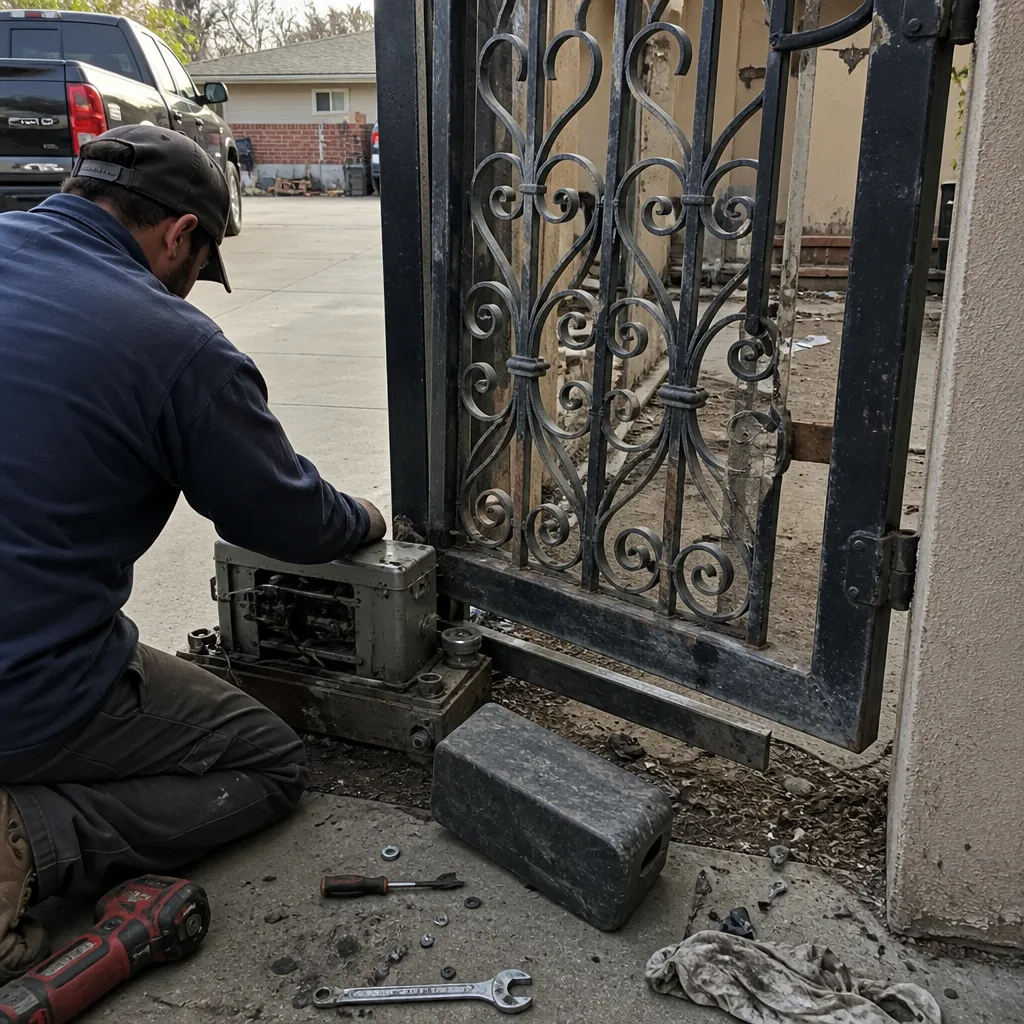 Before
 After
 Before
 After
 Before
 After