
Last updated October 30, 2026
 Wrought iron
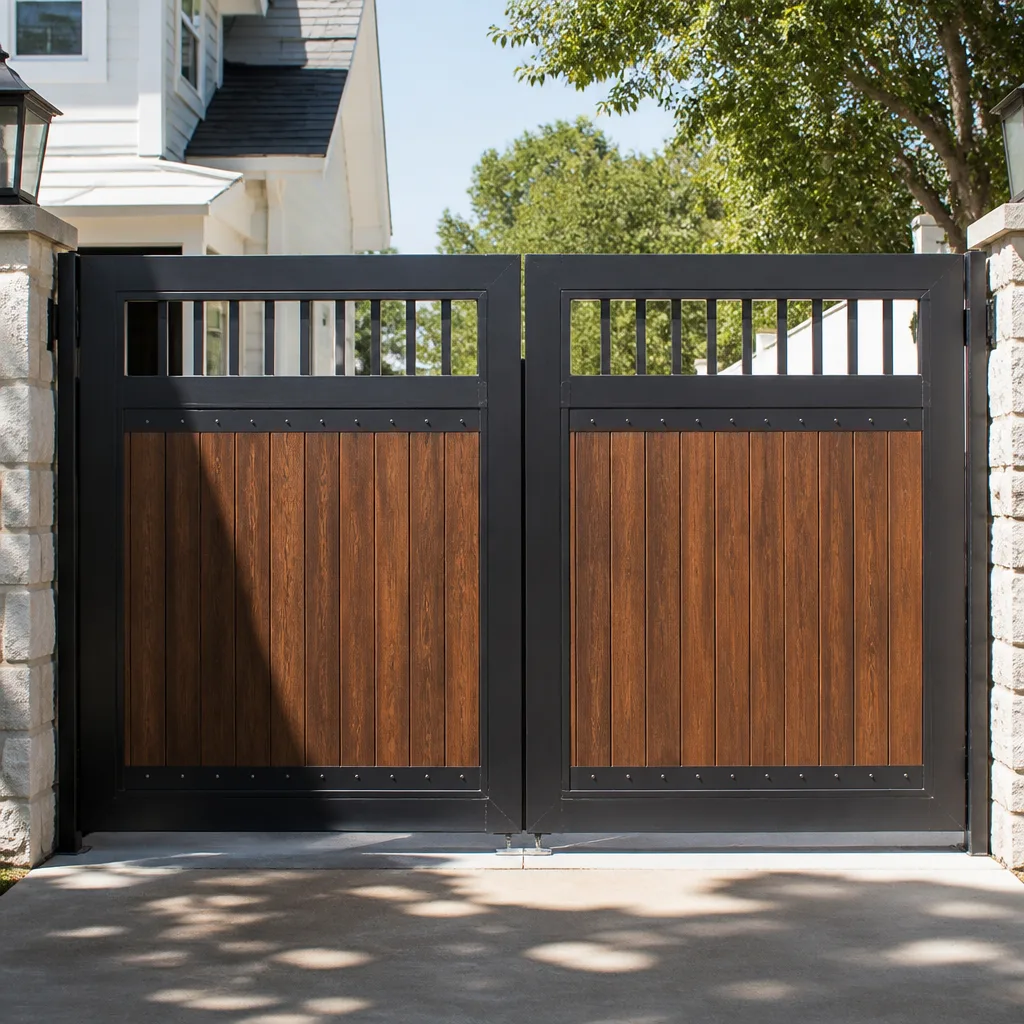 Wood & steel frame
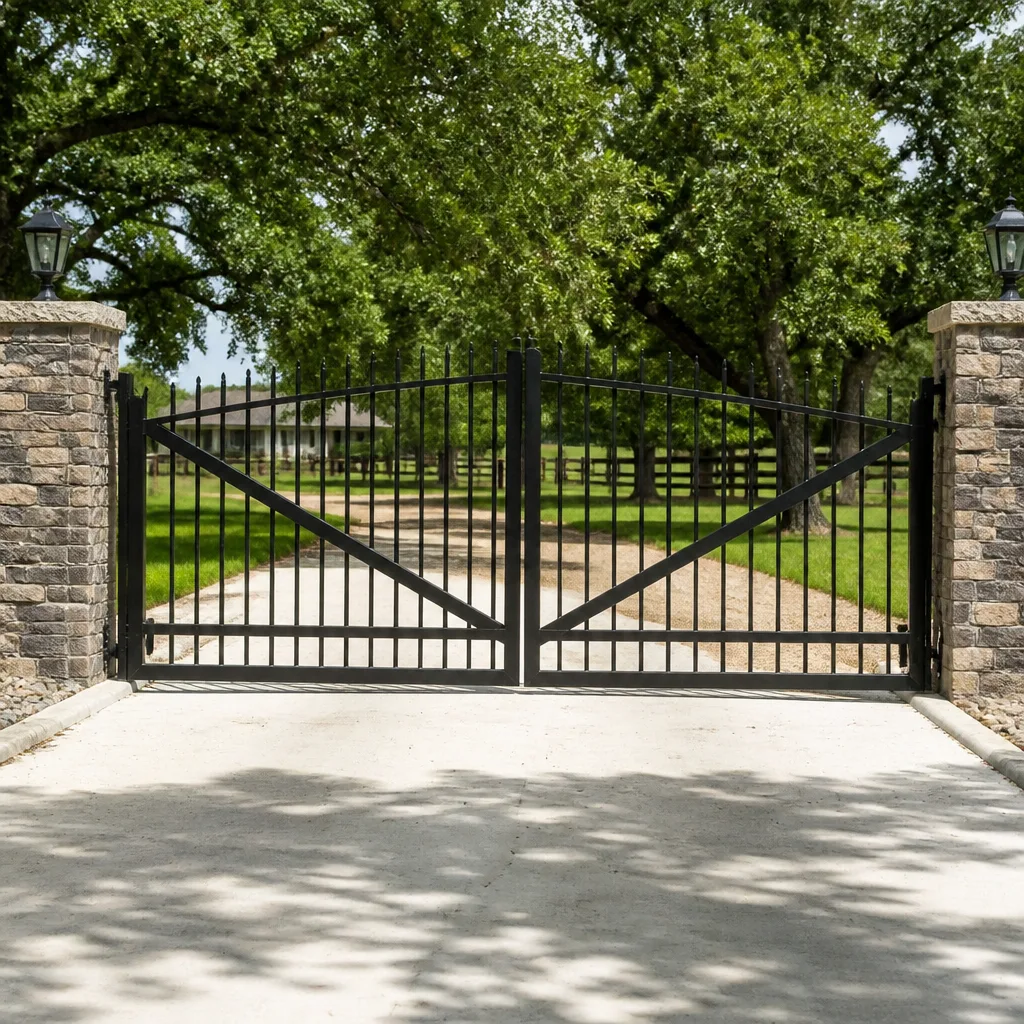 Farm & ranch
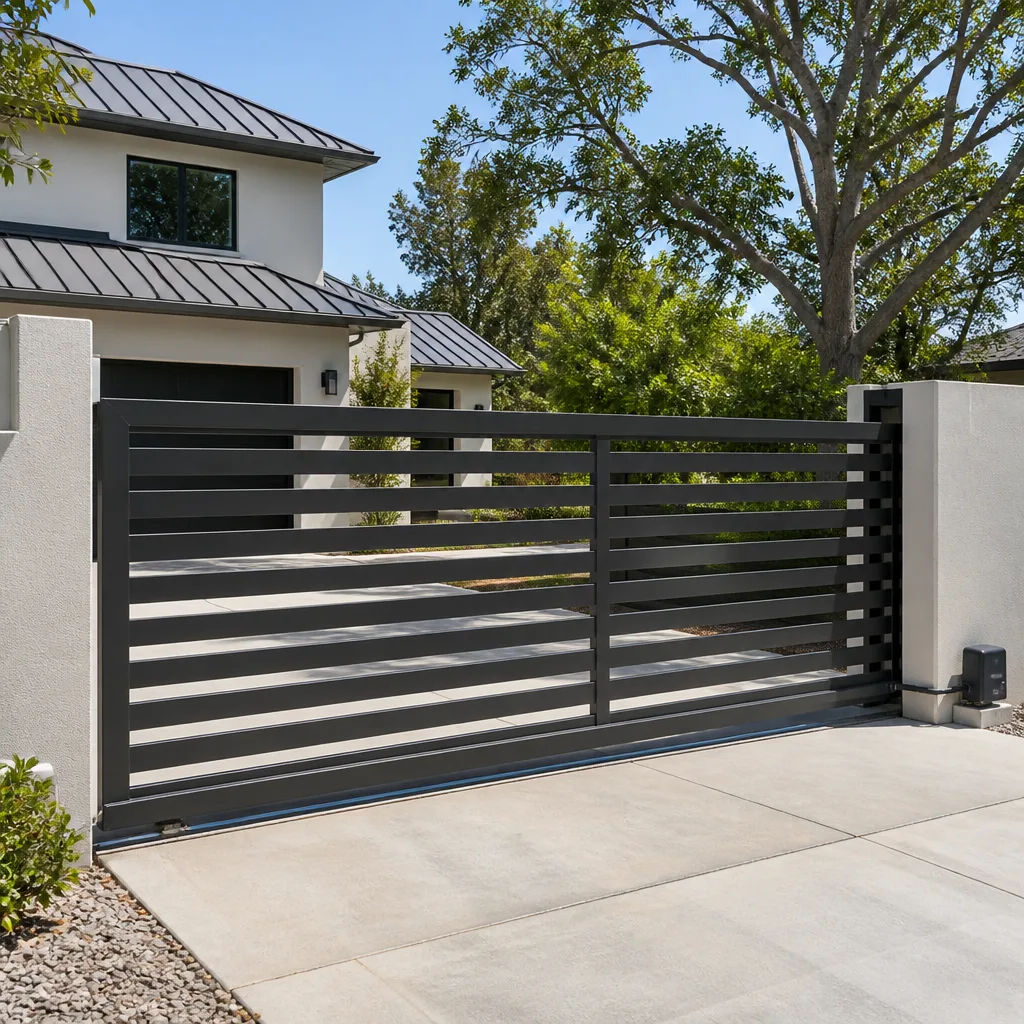 Sliding driveway gates
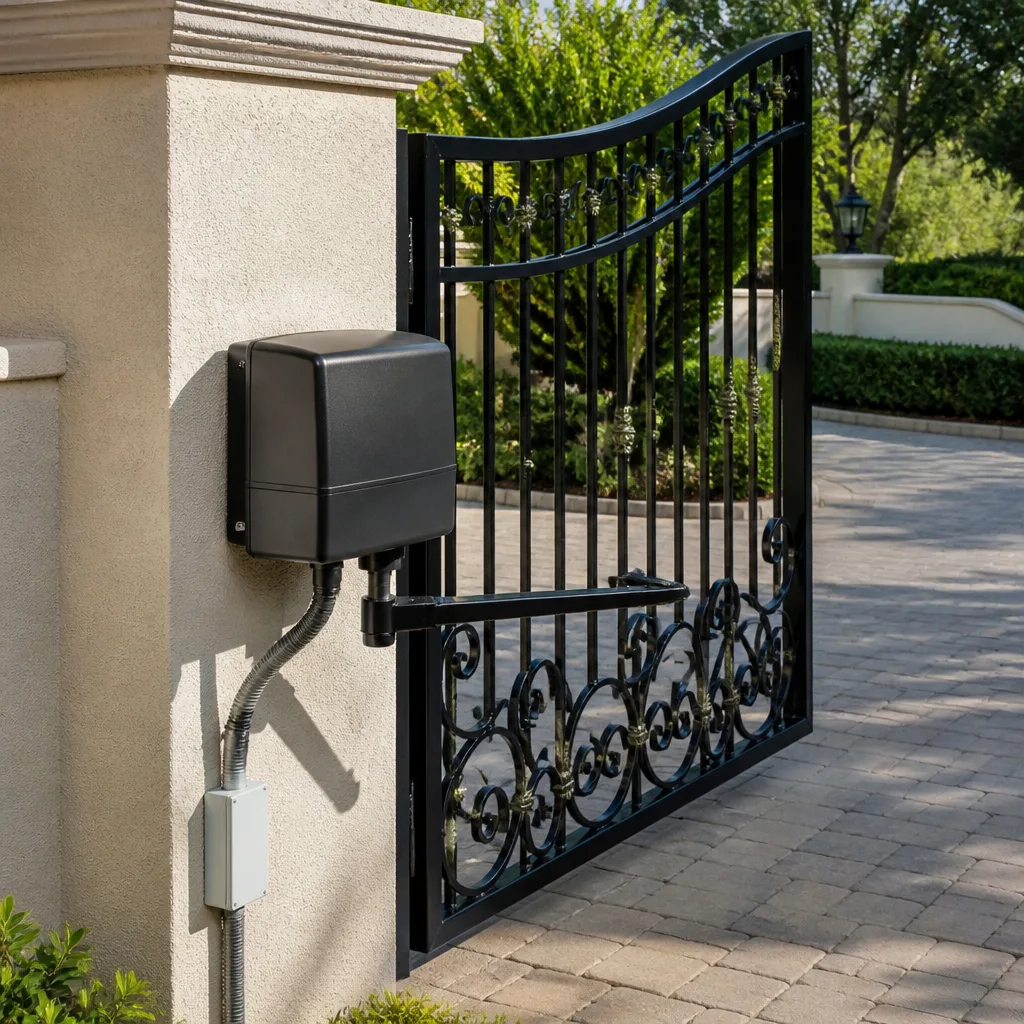 LiftMaster operators
Free on-site gate assessment - hinges, posts, and your LiftMaster or Nice gate operator checked before anything is quoted
The assessment is free and the quote is the invoice.
Get your free estimateThe Complete Gate Repair Guide for Chino Homeowners
In Chino, the gate at your driveway or community entrance takes a beating that gates in coastal cities simply never experience. Summer surface temperatures here regularly push past 150°F, and that’s before we talk about the alkali clay soil that shifts with every irrigation cycle and rain season. The result is a specific pattern of gate failures: welded joints pulling apart, swing gates sagging at the latch, operator arms bending under load they were never designed to carry. In our years working exclusively on gates in Chino, we’ve learned that most repair jobs could have been caught early if the homeowner knew what their gate was actually telling them. This guide walks you through every major failure mode we see in Chino, organized so you can diagnose what’s happening before you call for our Gate Repair services.
Quick Answer
Most gate failures in Chino trace back to soil movement, heat stress on metal components, or operator systems fighting a gate that no longer swings true. The fastest path to a lasting fix is identifying which of these three is driving your problem before you buy parts or call for service. A gate specialist can typically tell you over the phone whether you’re looking at a simple adjustment, a hinge replacement, or a full operator swap.
Styles & brands we work with
Table of Contents
- Why Chino’s Climate and Soil Are Harder on Gates Than You’d Think
- Common Manual Gate Failures and What They Actually Mean
- Electric Gate Problems: Operator vs. Gate – How to Tell the Difference
- Which Gate Operators We See Most in Chino and How They Fail
- HOA and Community Gates: The Preserve, Chino Hills, and What Changes
- Rust on Wrought Iron in a Dry Climate: Cosmetic vs. Structural
- When You Can Self-Diagnose vs. When You Risk Making It Worse
- What Gate Repair Costs in Chino Right Now
Why Chino’s Climate and Soil Are Harder on Gates Than You’d Think
Chino sits on a unique geological patch. The soil here is heavy with clay and alkali content, which means it expands when wet and contracts when dry, often unevenly across a single gate post. That differential movement is the single biggest reason we see misaligned gates in Chino that don’t show up in, say, Long Beach or Huntington Beach. A gate post set in this soil will heave upward or tilt over the course of a season, and once the post moves even half an inch, the geometry of the whole gate changes.
Here’s what that looks like in practice:
- The latch that used to catch cleanly now only engages halfway, or you have to lift the gate slightly to close it.
- The gate rubs against the post or the ground on one side, leaving fresh scrape marks or a worn path in the concrete.
- The top bar of a swing gate shows a slight twist when you sight down the line, even though nothing visible is bent.
These are not motor problems, and they’re not hinge problems. They’re post heave problems. The fix is resetting the post deeper or setting it in a more stable footing, and then re-hanging the gate to the new position. In Chino’s clay-heavy zones, we sometimes recommend a deeper set with additional concrete and gravel drainage at the base to slow the heave cycle. It’s not a flashy repair, but it’s the one that makes every other adjustment hold.
The heat is the second layer. Inland Empire summers push surface temperatures past 150°F, and a dark iron gate absorbs that heat all day. Metal expands, and on a gate with a tight reveal or a misadjusted operator, that expansion can be enough to trip a limit switch or bind a slide track. We see an uptick in “the gate won’t close all the way” calls in July and August that turn out to be thermal expansion, not a failed sensor or motor. The gate works fine at 7 a.m. and binds at 3 p.m. That’s a tell, and it points to an adjustment issue rather than a part replacement.
Common Manual Gate Failures and What They Actually Mean
A manual gate is simpler than an automated one, but simple doesn’t mean forgiving. The most frequent call we get for manual gates in Chino is a sagging swing gate, and here’s the thing: sag is rarely the hinge’s fault. It’s usually the frame’s geometry giving way under repeated stress, and the hinge is just where the movement becomes visible.
When a bottom hinge wears out, the gate drops at the latch side. The fix is replacing the hinge, but if you don’t address why the hinge wore, you’ll be replacing it again in eighteen months. Common underlying causes include:
- A gate that was hung without sufficient diagonal bracing, so the frame flexes on every cycle.
- A bottom hinge that’s undersized for the gate’s weight, common on older installations.
- A post that has tilted inward or outward from soil heave, transferring load to the hinge in a direction it wasn’t built to handle.
Slide gates fail differently. A wheel that seizes means the gate drags and the track wears unevenly. A bent track, often from a vehicle clipping the edge, forces the gate to bind at a specific point in its travel. These are mechanical faults with clear mechanical fixes: replace the wheel assembly, straighten or replace the track section, and re-level the carrier system. What our Gate Repair in Chino team looks for beyond the obvious is the secondary damage. A seized wheel doesn’t just stop the gate; it torques the frame and can crack a weld at the carrier mounting point. Fix the wheel, miss the crack, and you’re back out in three weeks for a bigger problem.
Weld failures on steel and wrought iron gates are another category entirely. In Chino’s dry heat, rust doesn’t eat through metal the way it does near the coast. But heat cycling does fatigue welds, especially at high-stress points like hinge mounts, latch posts, and where ornamental scrollwork meets structural rails. A weld crack looks like a hairline line at first, often with a faint rust weep that tells you it’s been breathing for a while. If you catch it at the hairline stage, it’s a quick grind-and-reweld. If you miss it, the joint separates and the gate drops or folds.
Electric Gate Problems: Operator vs. Gate – How to Tell the Difference
When an automated gate stops working, the first question is whether the problem is the operator (the motor and control board) or the gate itself. We get this wrong-headed diagnosis all the time: a homeowner replaces a perfectly good control board because the gate was binding, and the operator was overheating trying to move a gate that didn’t want to move. For a deeper breakdown, see DIY vs Professional Gate Repair: The Chino Homeowner’s Decision Guide.
Here’s a straightforward diagnostic sequence that works for most systems:
- Put the operator in manual release mode. If the gate swings or slides easily by hand, the problem is likely in the operator, the wiring, or the power supply. If the gate is stiff, heavy, or binding, the gate itself is the issue.
- Listen for what the operator does when activated. A click with no movement usually means a capacitor, a limit switch, or a locked rotor. A hum with no movement means the motor is trying but something’s binding. No sound at all points to power, fuse, or control board issues.
- Check whether the problem is consistent or intermittent. A gate that fails at 3 p.m. but works at 8 a.m. is often thermal. A gate that fails after rain points to a seal, a sensor, or a ground fault. A gate that fails randomly with no pattern points to a loose connection or a failing component on a board.
Chino-specific note: dust is a constant in the Inland Empire, and it gets inside everything. Optical safety sensors, limit switches, and even the contacts on a keypad all degrade from grit intrusion. If your safety sensors are tripping and the gate reverses for no visible reason, check whether the lenses are coated with dust before you assume the sensor is dead. A clean with a dry cloth fixes more “sensor failures” than any part replacement we do.
For a deeper dive on the electrical side, see our Electric Gate Repair in Chino page, where we walk through control board diagnostics and power issues in more detail.
Which Gate Operators We See Most in Chino and How They Fail
Chino’s housing stock spans several decades, which means the operator on your gate depends heavily on when your home or community was built and who the original developer contracted. Here’s what we actually see in the field:
FAAC systems are common on higher-end residential and some light commercial gates throughout Chino. FAAC hydraulic operators are known for smooth operation, but in our experience, their failure pattern in this climate is seal degradation from heat cycling. The oil weeps, the operator loses holding force, and the gate drifts. The fix is a seal kit and oil refresh, not a full operator replacement, unless the leak has run long enough to damage the pump.
Linear and Viking operators dominate the mid-range residential market in Chino. Linear’s weakness is the limit switch mechanism on older models, which wears and loses its setting, causing the gate to stop short or overtravel. Viking’s swing arms, especially the linear actuator designs, develop bushings wear that produces a knock at the start and end of travel. Both brands are highly repairable, and we keep parts for them because they’re everywhere in this part of the Inland Empire.
BFT systems show up on some commercial and HOA installations. Their control boards are sensitive to power quality, and Chino’s grid isn’t always clean. A voltage spike from a summer brownout can fry a BFT control board in seconds, and the fix is a board replacement plus a surge suppressor installation so it doesn’t happen again. Some of the newer BFT models have integrated surge protection, but older ones don’t.
What this means for you: the operator brand matters when it comes to failure patterns, but the gate’s mechanical condition matters more. An operator in good health will still fail early if it’s pushing against a misaligned or sagging gate. That’s why our Wrought Gate Repair home diagnostic always starts with the gate itself, not the control box.
HOA and Community Gates: The Preserve, Chino Hills, and What Changes
Gated communities in Chino, particularly The Preserve and the larger HOA-governed neighborhoods in Chino Hills, operate under a different set of constraints than a custom home on a private lot. The gates are bigger, they cycle more often, and they’re governed by access control systems that layer additional failure points on top of the mechanical gate itself.
The most common failure pattern we see in HOA environments is not a broken gate; it’s a mismatched repair. A community contracts out gate repairs to whichever bid comes back cheapest, the tech replaces the obvious part, and six months later the same gate fails for a different reason. One gate in a Preserve community went through three operator replacements before anyone diagnosed the real issue: the gate’s roller assembly was seizing intermittently, drawing excessive current, and burning out operators prematurely. The operator was never the root cause.
There’s also the access control layer. Keypads, card readers, vehicle detection loops, and phone entry systems all integrate with the gate operator, and a failure in any of them presents as “the gate doesn’t open.” We see loop detector failures in Chino HOA communities disproportionate to other areas because the buried loops settle in the clay soil and the wire breaks. A broken loop means the gate won’t auto-close after a car passes, or it may sit open or closed and ignore the exit sensor entirely.
For HOA managers, the recommendation is simple: have a specialist inspect the full system once a year, not just when a resident reports a failure. The inspection pays for itself in avoided emergency calls and community complaints. Single-company accountability means one number to call, and the same team that diagnoses the mechanical gate understands the automation and access control attached to it.
Rust on Wrought Iron in a Dry Climate: Cosmetic vs. Structural
Homeowners from the East Coast or the Gulf often expect rust to be an aggressive, pitting force that eats through metal in a few years. In Chino’s dry climate, rust behaves differently, and understanding the difference between cosmetic and structural rust will save you from either ignoring a real problem or paying for a cosmetic fix that wasn’t urgent.
Cosmetic rust in Chino is surface oxidation that appears as a uniform orange-brown film or small speckles. It’s common at welded joints, on edges where the original paint has worn thin, and at the base of pickets where irrigation sprinklers hit the metal. It’s ugly, but it doesn’t compromise the gate’s strength. The fix is preparation and repainting: wire brush or media blast to remove the oxidation, a rust-inhibiting primer, and a topcoat designed for metal in high-UV environments. Skip the primer and the rust returns within a season.
Structural rust is different. It appears as flaking, scaling, or deep pitting that removes material, and it’s most dangerous at the bottom rail of a swing gate, where water sits after rain or sprinkler contact, and at the hinge mounting plates hidden behind the post. A gate that’s losing material at the bottom rail will eventually sag, then crack. We inspect for structural rust by tapping suspect areas and looking for soft spots or visible layering in the metal. If the metal has lost more than about a third of its cross-section, replacement of that section or the entire gate is the honest recommendation, not another patch.
Chino’s hard water also leaves mineral deposits on gate surfaces when irrigation overspray dries. Those white crusty deposits aren’t rust, but they trap moisture against the metal and accelerate oxidation underneath. If you see mineral buildup at the base of your gate, adjust the sprinkler heads to stop hitting the metal, and clean the area before you paint.
When You Can Self-Diagnose vs. When You Risk Making It Worse
There’s a line between being an informed homeowner and turning a $200 repair into a $2,000 one, as we explore in The Complete Guide to Gate Repair in Chino. Here’s where that line sits for most gate systems in Chino.
Safe to self-diagnose or address:
- Cleaning dust off photo-eye sensors and confirming they’re aligned.
- Checking whether the gate binds by putting it in manual mode and moving it by hand.
- Tightening visible loose bolts on hinge plates and latch hardware.
- Lubricating accessible hinge pins and roller assemblies with a dry lubricant.
- Confirming power at the outlet and checking for a tripped breaker or GFCI.
Call a professional before you touch it:
- Any repair involving the operator’s internal components, including capacitors, which hold a charge even when the power is off.
- Adjusting or replacing torsion springs on heavy swing gates; these springs store enormous energy and can cause serious injury if released incorrectly.
- Any repair on an HOA or commercial gate where access control wiring is involved.
- Weld repairs on a gate that’s sagging or loaded; the gate needs to be properly supported before grinding or welding.
- Any situation where the gate is off its track, hanging from one hinge, or otherwise unstable.
The warranty consideration also matters. If your gate or operator is under warranty, opening the control box or adjusting the limits yourself may void coverage. Most operator manufacturers write their warranties to exclude damage from unauthorized modification or improper adjustment. If in doubt, call first. A specialist can tell you whether it’s a warranty issue before you either risk the coverage or pay for a repair the manufacturer should cover.
If the diagnosis points to replacement rather than repair, see our Gate Installation in Chino guide for what a full installation involves, including proper post setting for Chino’s soil conditions.
What Gate Repair Costs in Chino Right Now
Costs vary significantly depending on the gate type, the failure, and the operator brand, but here’s a realistic range for what we’re seeing in Chino as of this writing:
- Hinge replacement on a standard residential swing gate: $180 to $450 depending on hinge type and gate weight.
- Post reset due to soil heave: $350 to $900 including concrete work and re-hanging.
- Operator arm replacement (non-hydraulic): $250 to $700 depending on brand and whether the control board needs recalibration.
- Control board replacement: $300 to $850; BFT and Viking boards run higher than most Linear replacements.
- Safety sensor replacement and alignment: $120 to $300 including labor.
- Full operator replacement (parts and labor): $1,200 to $3,500 depending on the system, the gate size, and whether new access control components are needed.
- Track and wheel replacement on a slide gate: $400 to $1,200 depending on gate weight and track length.
- Cosmetic rust treatment and repainting: $200 to $600 for a standard two-leaf swing gate.
Every estimate from us is quoted and agreed before any work starts. You know the number, the scope, and what’s included. We don’t do vague quotes that balloon after we’ve opened the gate up.
Common Mistakes to Avoid
- Ignoring a gate that’s getting harder to open or close. Binding gets worse, not better, and the operator is the expensive part that fails from fighting the gate. Every month you wait adds wear that shortens the operator’s life.
- Lubricating the track or rollers with WD-40. WD-40 is a solvent, not a lasting lubricant, and it attracts dust in Chino’s dry air and turns into a grinding paste. Use a dry lubricant designed for metal-on-metal contact.
- Replacing the operator without checking the gate’s mechanical condition. A new motor on a binding gate is just a more expensive version of the same problem. Test the gate manually first.
- Welding a cracked gate without supporting the load first. A gate under tension will grab the weld bead and crack again, often worse. The gate needs to be unloaded and the root cause addressed.
- Painting over rust without removing it. The rust continues under the paint and the coating fails from the inside out. Prep is the repair; the paint is just the finish.
- Assuming an intermittent problem is in your head. Intermittent failures have causes; they’re just harder to catch. Document when it happens, the temperature, and anything unusual, then have a specialist chase it with that information.
- Choosing a generalist for gate-specific work. A fence company or a handyman doesn’t stock FAAC or BFT parts, doesn’t know Viking’s limit switch quirks, and doesn’t fix gates all day every day. The hardware store advice you get from a generalist often costs more than the specialist would have charged to do it right the first time.
See the difference
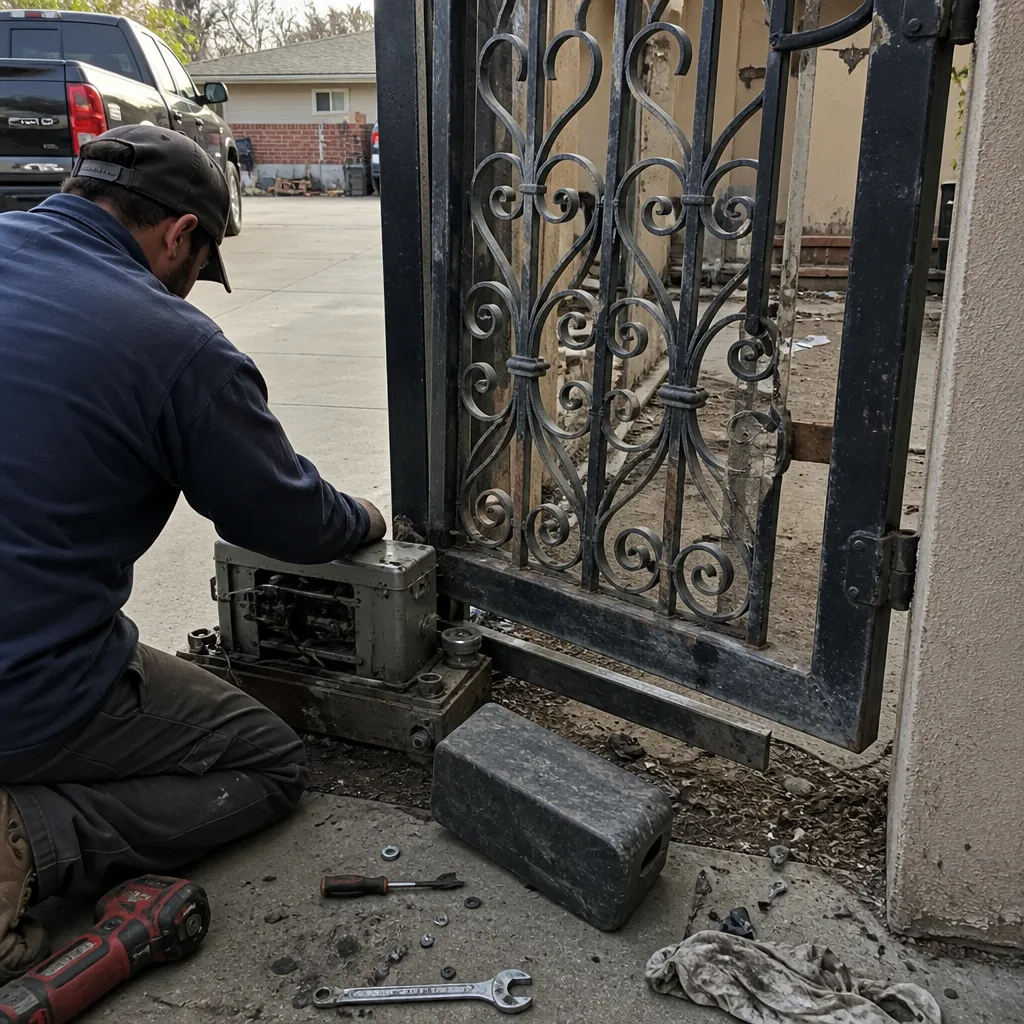 Before
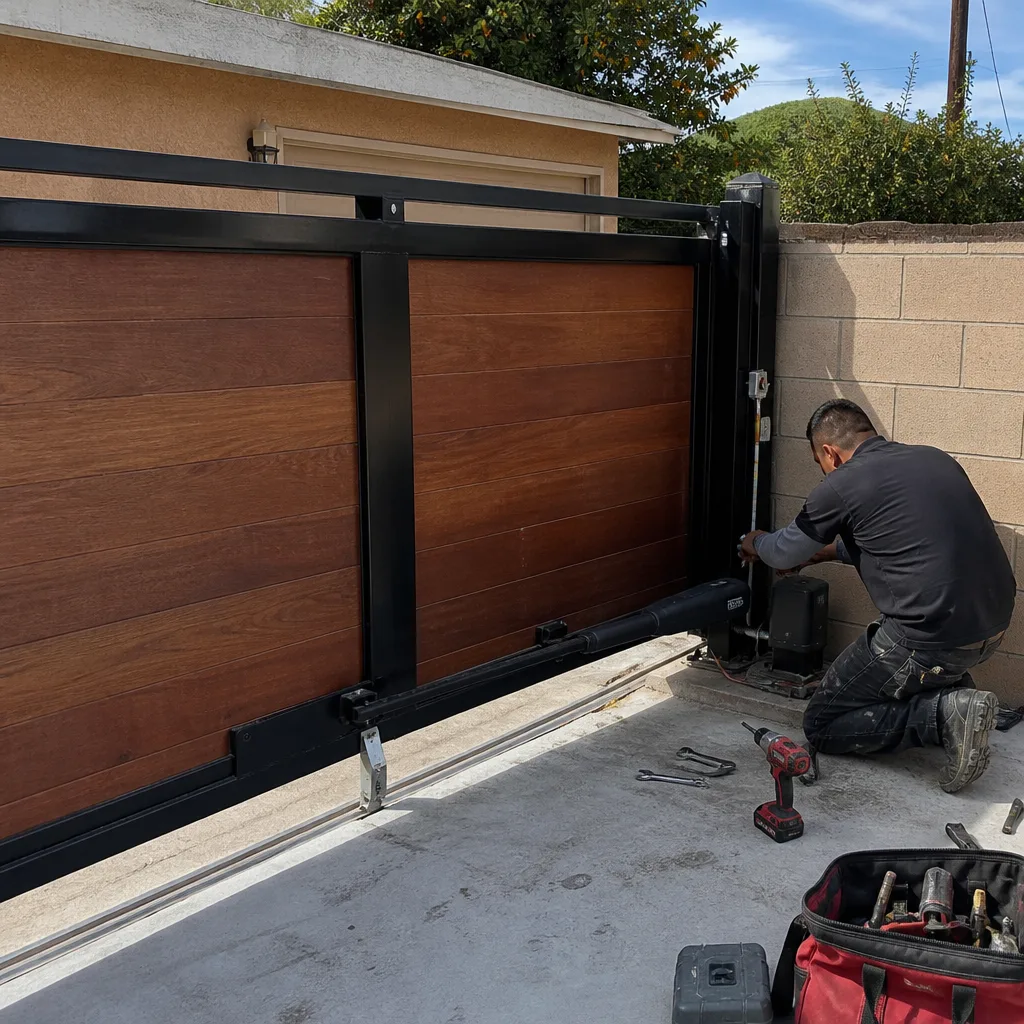 After
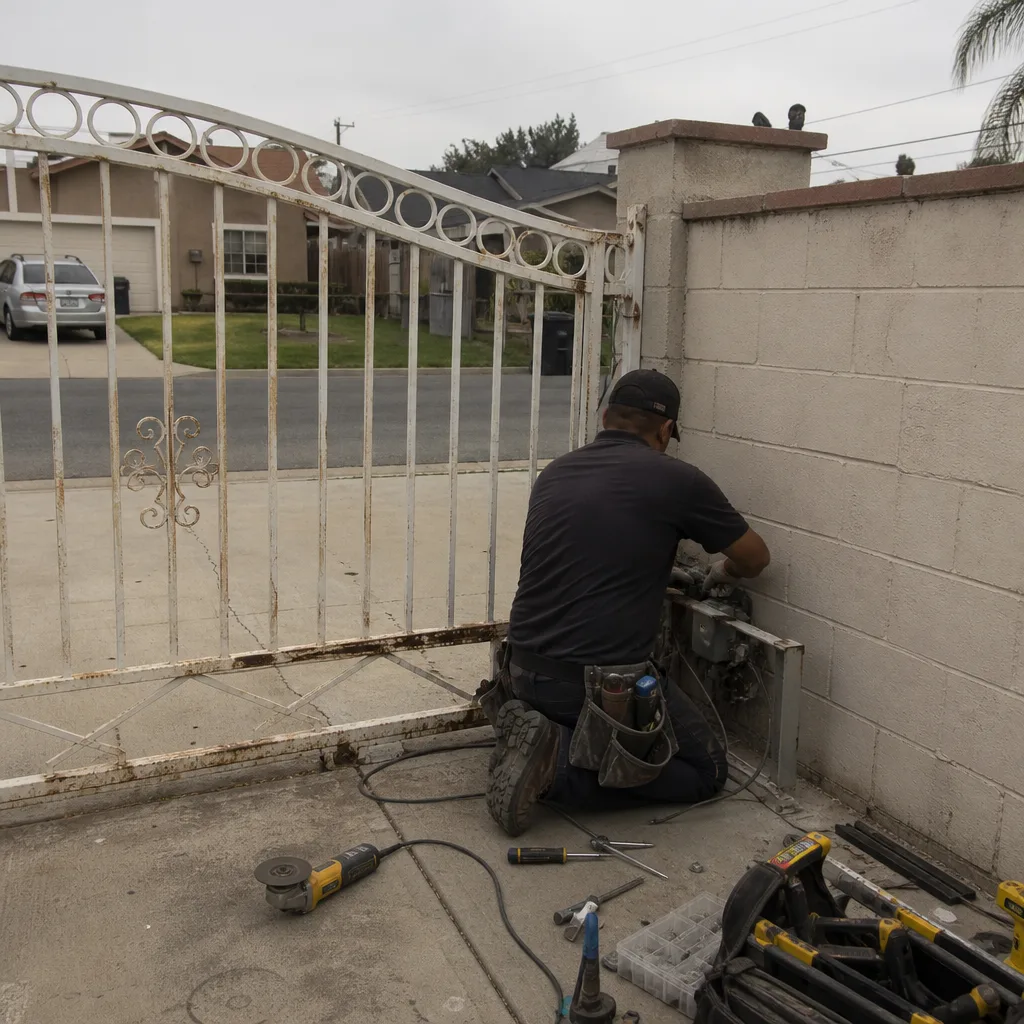 Before
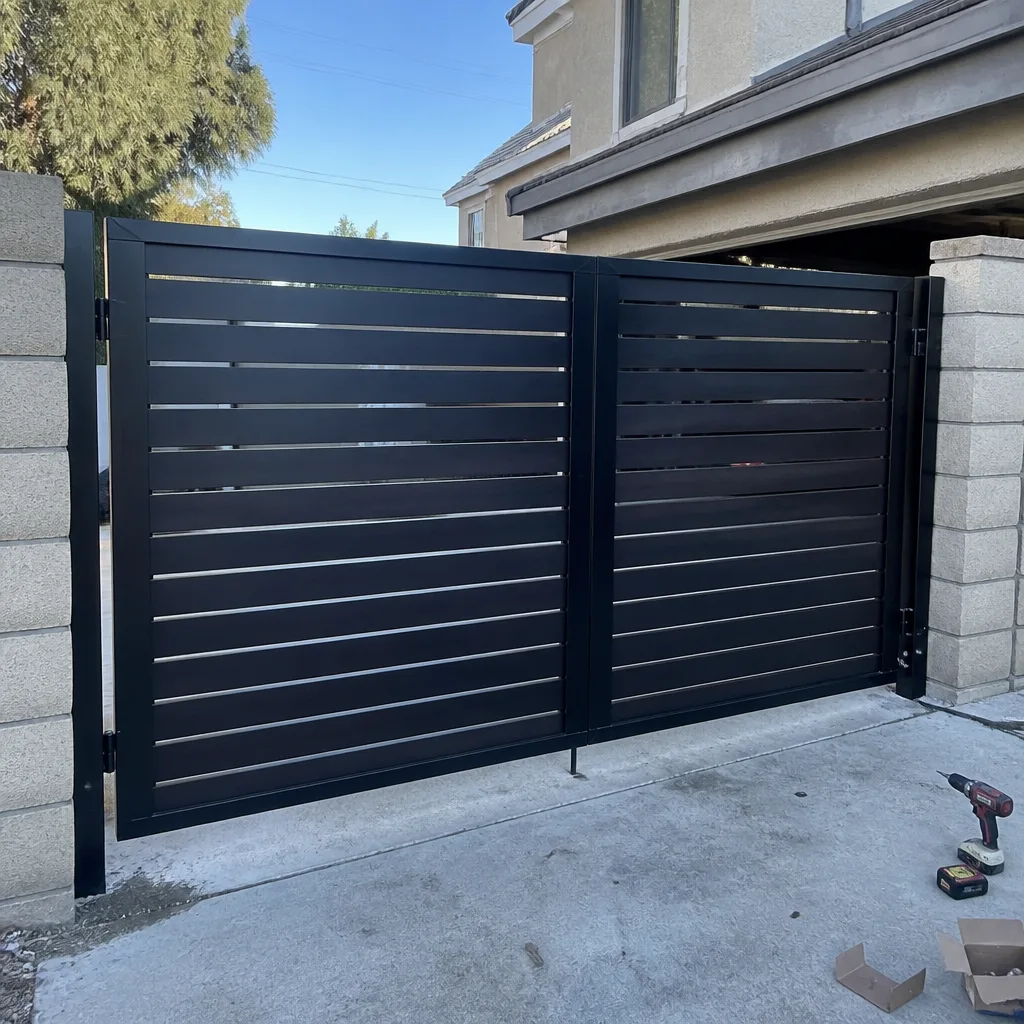 After
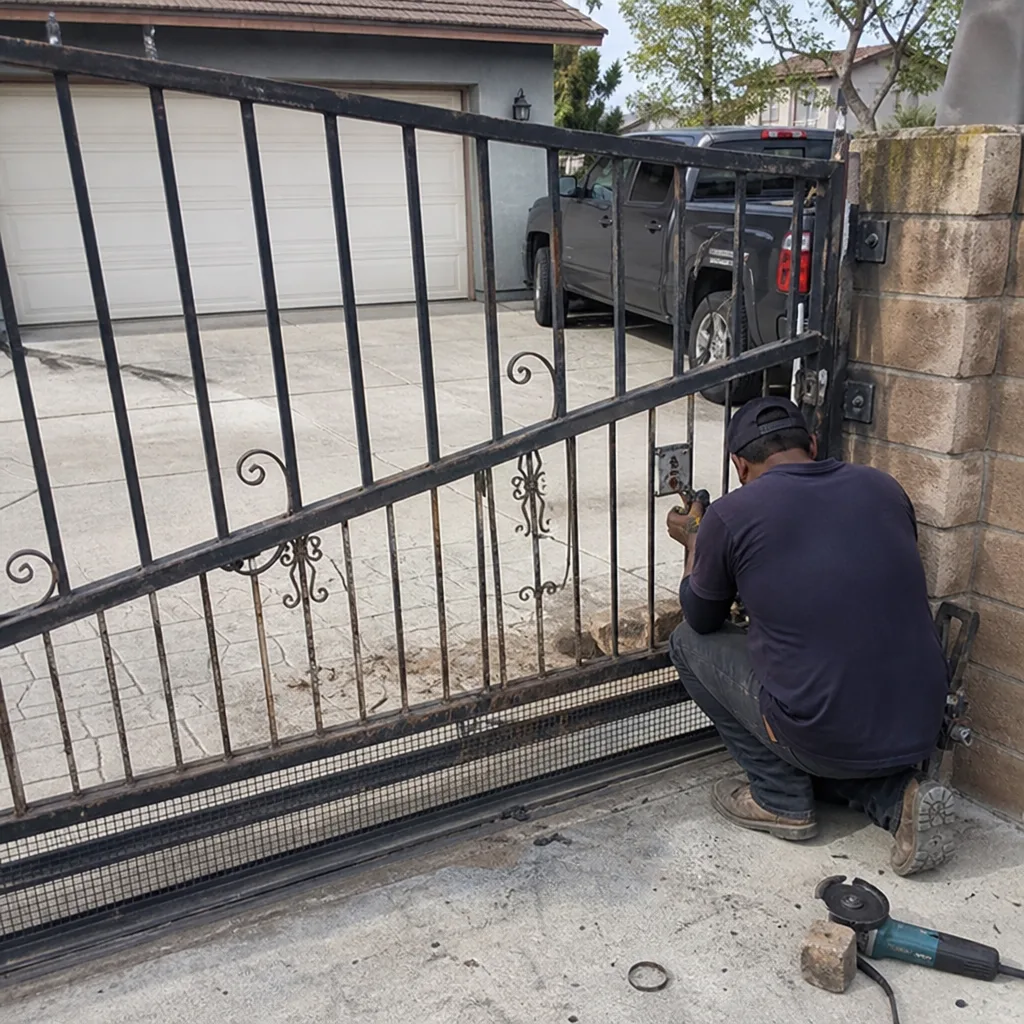 Before
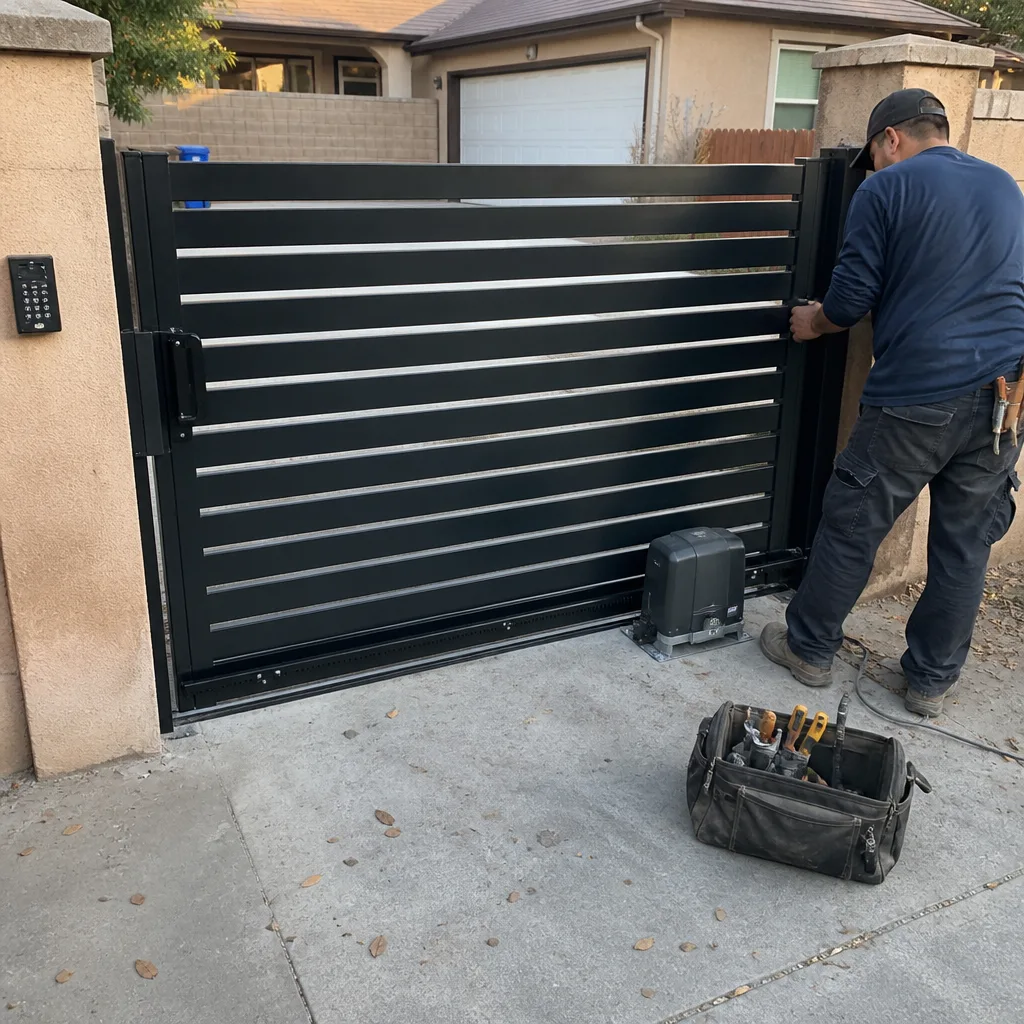 After
When to Call a Professional
Call us when the gate is binding, sagging, making noise it didn’t make before, or failing intermittently in ways you can’t replicate on demand. Call us when you smell burning near the operator, when the gate reverses for no reason, when a weld has cracked, or when a post has visibly moved. And call us before you buy parts based on an internet video or a forum thread. What one gate needed isn’t necessarily what your gate needs, and the brands we service, including FAAC, BFT, Linear, and Viking, all have their own failure patterns that a generalist won’t recognize. Wrought Gate Repair offers free estimates in Chino. Call (833) 545-6817 and tell us what you’re seeing. We’ll tell you what it sounds like, what it likely costs, and whether it needs a same-week visit or can wait.
Frequently Asked Questions
Most gate repairs in Chino fall between $180 and $900 depending on whether the issue is a hinge, a sensor, a post, or an operator component. Full operator replacements start around $1,200 and can reach $3,500 for larger systems. Call (833) 545-6817 for an exact quote – estimates are free.
Same-day service depends on the failure and our current schedule in Chino, but most common repairs like hinge replacements, sensor realignment, and limit switch adjustments are same-day jobs. Emergency gate-down situations where security is compromised get prioritized. Call us at (833) 545-6817 and we’ll tell you honestly what’s possible today.
That pattern almost always points to thermal expansion in Chino’s summer heat. The metal expands through the day, reducing clearances and tripping limit switches or binding the gate. It’s not a motor failure; it’s an adjustment issue, and the fix is usually re-setting travel limits and clearances with the gate at operating temperature.
Yes. We work exclusively on gates, including the larger automated and access-controlled systems common in Chino’s HOA communities. That includes the gate operator, the access control integration, the vehicle detection loops, and the mechanical gate itself, with one company accountable for the whole system.
We service FAAC, BFT, Linear, Viking, and several other major brands common in Chino’s residential and commercial gate systems. If you’re not sure what’s on your gate, we can identify it from a photo or during the estimate visit.
That depends on the extent of the rust, the condition of the posts, and the quality of the original fabrication. Wrought iron gates are often worth repairing if the frame is sound and the rust is cosmetic or localized. If structural rust has compromised the bottom rail or the hinge mounts, replacement is usually the better investment, and we’ll tell you straight which way to go.
The Bottom Line
Chino’s climate and soil create gate failures that don’t show up in most repair guides. Post heave from alkali clay, thermal expansion in summer heat, dust intrusion into sensors and limit switches, and HOA access control integration all add layers to what might look like a simple gate problem. The fix is understanding the root cause, not just the visible symptom. Manual or motorized, FAAC or Viking, the pattern holds: a gate that’s mechanically sound will protect your property and run reliably for years, and a gate that’s fighting its environment will eat operators and hinges until someone addresses the real issue. If your gate is telling you something, listen to it, call a specialist, and get it handled before the small problem becomes an expensive one. For more guides & resources, visit our blog.
Written by the team at Wrought Gate Repair, serving Chino since 2012.